There are environmental limits to economic growth

Economist Paul Krugman evidently feels irked and irritated by the notion that there might be limits to economic expansion: he has followed up his New York Times op-ed of September 18 (“Errors and Emissions,” to which I replied here) with a new piece titled “Slow Steaming and the Supposed Limits to Growth. It’s interesting to examine his latest assertions and arguments one by one, as they reveal a great deal about how economists think, and why they tend to disregard physical science when it comes to questions about finite resources and the possibility of infinite economic growth on a small planet.
Mr. Krugman begins by noting: “We seem to be having a moment in which three groups with very different agendas—anti-environmentalist conservatives, anti-capitalist people on the left, and hard scientists who think they are smarter than economists—have formed an unholy alliance on behalf of the proposition that reducing greenhouse gas emissions is incompatible with growing real GDP.” He omits mentioning a fourth group—ecological economists like Herman Daly, who take the position that, in the real world, the laws of physics and ecological limits trump economic theory. For Krugman, only mainstream economists are to be trusted; everybody else is prone to misconceptions. He seems perplexed why so many people are coming to the same mistaken conclusion from different directions. Could it be that they are all recognizing an unavoidable physical reality?
Next Mr. Krugman fires a volley at physicist Mark Buchanan’s recent essay, Economists are blind to the limits of growth. Back in the 1970s, Krugman’s mentor, Bill Nordhaus, led mainstream economists in denouncing the classic book Limits to Growth. Unfortunately for Krugman, Nordhaus’s attack looks in retrospect like mere hand-waving: analysis of relevant data from the last 40 years shows that the most pessimistic scenario from the 1972 Limits to Growth study is tracking reality quite closely.
Mr. Buchanan’s pithy piece zeros in on energy as the most important limit to endless economic expansion. But even though he carefully explains that we are getting more efficient at using energy (and balances that recognition with evidence that, despite this, economic growth implies using more energy overall), Mr. Krugman pretends that physicists have never heard of energy efficiency. He spends most of his op-ed explaining one instance (ocean-going freighters reducing their speed to use less fuel) as if this were proof of a new and pivotal principle that no hard scientist had previously noticed. Are there instances where we can use less energy while achieving the same effect? Of course! A better, though more shop-worn, example would be lighting: as a result of the introduction of compact fluorescent and LED lights, we’ve seen dramatic reductions in the amount of energy used to banish darkness from cities and homes.
But Mr. Krugman doesn’t follow through on his argument. If he is implying that there are no limits to growth because energy use can be made more efficient, then logically he must also argue that energy efficiency can be improved endlessly—at least to the point at which no energy at all is needed in order to run the economy (I say “at least,” because presumably even then further growth would be needed in order to prove the non-existence of limits). But of course that’s pure fantasy, as every physicist knows. Energy is defined as the ability to do work, and the ability to do work is what generates GDP. Energy efficiency can often be improved, but such improvements are subject to the law of diminishing returns: the first five percent of improvement is cheap, the next five percent costs more, and so on. Perfect efficiency in any process is either impossible to achieve, or infinitely expensive (depending on how you prefer to look at it).
My guess is that if and when Mr. Krugman honestly confronts the logical impossibility of infinite growth within a finite system, and the similar impossibility of infinite improvements in energy efficiency, he will retreat to saying something along the lines of, “Yes, but even if there are theoretical limits to growth, we’re very far from reaching them, so they’re practically irrelevant for the time being.” However, once one acknowledges that there are indeed theoretical limits to expansion, one must then ask, “What would be the likely signs that we are approaching those limits?”
I’ll suggest some: overall rising energy costs (indeed, energy production consumes a larger proportion of global GDPtoday than it did a decade ago); falling yields of minerals per unit of energy applied to mining and refining (this is now true almost across the board, from antimony to zinc); rising environmental costs and risks from industrial processes (see “climate change”).
Mr. Krugman writes: “So where does the notion that energy is somehow special come from? Mainly, I’d say, from not thinking about concrete examples . . . because if you think about actual economic activities even briefly, it becomes obvious that there are tradeoffs that could let you produce more while using less energy.” Again, that’s a statement no one would argue with. But Krugman’s own example of energy efficiency highlights the fact that there are often hidden costs to efficiency efforts. He writes that “After 2008, when oil prices rose sharply, shipping companies . . . responded by reducing the speed of their ships. It turns out that steaming more slowly reduces fuel consumption more than proportionately to the reduction in speed.” But moving ships slower meant deploying more ships to in order move the same amount of freight—thus substituting capital and labor for energy. This strategy didn’t require the development of new technology; the shippers were “just using the same ships differently.”
In the comments to Mr. Krugman’s op-ed on the New York Times website, Ken White (one of my colleagues at Post Carbon Institute) points out that all those extra ships represent plenty of embodied energy, which was expended in extracting and refining ores and in other aspects of ship construction. When we look at many (not all) efficiency gains this way—that is, from a systems perspective—much of the advantage tends to disappear. Does the added cost of embodied energy in this case equal the energy of the fuel saved? I don’t have the data and haven’t done the calculations, but even if there are some net savings they are probably much smaller than Krugman assumes. You can substitute capital and labor for energy in some instances and up to a point, but there is literally nothing that anyone can do without some expenditure of energy. Substitution itself is subject to limits.
Mr. Krugman clearly implies that it is only mainstream economists who think about concrete examples like the one just discussed; in contrast, hard scientists deal just in airy abstractions. For physical scientists, this must be surprising news, as most of them deal with concrete examples on a daily basis.
Here are some concrete examples:

Why is Mr. Krugman leading a crusade against the idea of environmental limits to economic growth? I believe there’s a political agenda at work here, and that it’s driven by laudable sentiments. I normally hesitate to guess at other people’s motives, but in this instance they are rather plainly implied in Krugman’s two opinion pieces cited above. He evidently is deeply concerned about climate change and wants to see humanity avert the worst likely impacts, but he believes that policy makers can never be persuaded to adopt climate protection policies if that requires reining in economic growth. He writes: “[T]here’s a lot of room to reduce emissions without killing economic growth.” Yes, there’s room.According to a study Krugman himself cited in his previous op-ed, the first 10 percent of emissions cuts can be achieved without much pain. But beyond that, they’re all at a net cost to the economy.
Like Paul Krugman, we at Post Carbon Institute are deeply concerned about climate change and want officials to adopt policies to avert it. It’s true: if informed opinion leaders pretend that full climate protection can be achieved without any real cost, politicians are more likely to sign on to available no-cost policies. But they’ll only be agreeing to weak pledges that will fail to achieve the levels of emissions cuts that are actually required. By misleading policy makers and the general public this way, we merely waste time and opportunity.
By acknowledging that climate change is a serious threat to humanity’s future, Mr. Krugman is in effect acknowledging the existence of environmental limits to economic expansion. He would probably object that climate change is merely a limit to a fossil-fueled economy, and that a renewably-energized economy could happily expand forever. But once we open the limits box and peer inside, a long series of other critical boundaries quickly comes to light.
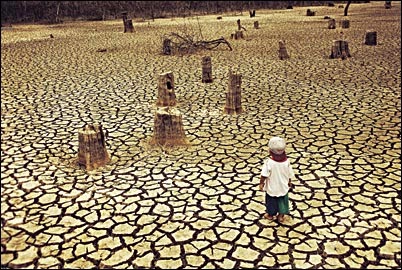
Let’s get real. The Earth is a bounded sphere, and the human economy is an engine that extracts raw materials and produces waste. If we keep that engine’s operation within the bounds of what our planet can absorb or replenish through its normal ecosystem functions, all is well. But if the economy continues to grow year after year, at some point the planet’s systems will be overwhelmed—even if we’re using renewable energy to extract and transform raw materials. Our uses of energy and materials can be made somewhat more efficient, but only up to a point. If the Earth itself were expanding at an ever-increasing rate, perpetual economic growth would pose no problem. Yet last time I checked, the planet hadn’t gotten any bigger—while our demands upon it continue to increase.
In his latest op-ed, Mr. Krugman derides “hard scientists who think they are smarter than economists.” I can think of several snide responses to that characterization, but actually I don’t think one is required. The phrase speaks volumes about economists’ own hubris.

Networked, open-source, open-access, exponentially-increasing productivity in the hands of the masses…

I’ve just returned from an eye-opening, mind-expanding week in Leipzig at the 4th Annual global Degrowth congress. This vibrant gathering brought together over 3,000, mostly young, ‘prosumer’ activists and practitioners from a variety of new economy movements.
While there I learnt a huge amount from makers, hacktivists, anarcho-syndical cooperativists, collaborative-commoners, anti-capitalists, free-culturalists, buen-vivir, transitioners, Fab-Lab-ers, p2p-ers and social-entrepreneurs from places as diverse as Spain, India, Bolivia and Brazil. And continuing the theme of new economics, on the train back I read Jeremy Rifkin’s important new book the «The Zero Marginal Cost Society – the internet of things, the collaborative economy, and the eclipse of capitalism.»
In preparation for Degrowth I also spent three days in Meissen on a deep-dive with a small group of p2p and commons movement leaders including David Bollier andMichel Bauwens who, in the introduction to his book, both praise Rifkin as a visionary of a new world order.
I was in Germany as part of the research and outreach for work on the Real Economy Lab, an initiative that aims to help connect theory and practice through a collaborative mind-mapping of the wider ecosystem of the post-growth new economy movement. The hope is that this process can form the start of a global alliance building to converge these various new economy movements into one force for good.
Germany was a good place to start as its probably the country furthest ahead in the combination of the Internet of Things, renewable, decentralized and community controlled energy, grassroots commons activists and ‘makers’.
One thing everyone I met have in common is a desire to create a new world order, a new way of creating, connecting and being which is beyond the market, beyond ownership, growth and capitalism. To them the idea of working for a large company for a wage has just never even been on the radar. Indeed the idea of large, shareholder owned private enterprises doesn’t feature in the world they are co-creating. Many of them have also conceptually, and in some cases, such as Cooperativa Integral Catalana, literally moved beyond any real relationship with politics and the state. Indeed, even the cutting edge of politics, Citizen-democracy parties like Partido X and Podemos, are running fast just to try to keep up with the convergence of these movements.
Emerging from this convergence is a powerful vision of a new world order and paradigm which represents real hope of building a bottom-up safety-net to catch the ever-more fragile top-down, as it unravels and collapses around us.
The new paradigm these movements are creating is post-enlightenment, lateral not hierarchical, chaordic, networked, decentralist, inclusive, open, rebellious and fun. It represents a near future that will test and fail much of the incumbent and dying models of politics and business. And it cocks a snoot at the Lockean, Millian and Social-Darwinian paradigm and story that has so atomised, excluded and isolated us from each other and so ravaged the planet.
What have till now been separate movements of the co-operative, commons, p2p, Transition and Makers are converging and learning that they have much in common and that if they stand and develop together they can be more than a side-show and thorn-in-the-side of the mainstream — they can become the mainstream in a new post capitalist, post growth world.
Jeremy Rifkin’s new book The Zero Marginal Cost Society is, along with Naomi Klein’s new «This Changes Everything – capitalism versus the climate,» a current must read. It documents an on-going shift to what Rifkin calls the Third Industrial Revolution. And it summarizes much of what I experienced last week in Leipzig about the coming together of the Internet of Things (IoT), the p2p worlds, the collaborative-commons and new economy movements.
Rifkin points to a central contradiction of capitalism which I find a useful addition to the new economy theories of people like Professors Schweickart, Olin-Wright and Alperovitz. This is that capitalism’s inbuilt dynamism drives it necessarily, if left to a truly free market, towards near-zero marginal costs of production for additional production units — what Rifkin calls ‘extreme productivity’. The implications of this are revolutionary — once at near-zero the system’s inbuilt dynamics stall and start to unravel — «goods an services become nearly free, the exchange of property on markets shuts down and the capitalist system dies».
Thus the very DNA of capitalism, that which has made it such a success, has within it its own lethal sting in the tail. Its designed to kill itself. And to kill off any enterprise, such as the private shareholder owned corporate, reliant on its continuing. Capitalism has done its job and made itself redundant. If only we had made it to where we are now, on the edge of near-zero marginal costs, and the new economy it heralds, maybe40 years ago, we might not now be in our nose-dive into possibly unstoppable, runaway climate chaos.
Rifkin’s view is that we are seeing the eclipsing of capitalism as a system and that incumbent centralised and vertically integrated profit-orientated businesses, whilst they will try to mimic, learn from and slip-stream this new order, will at best be carried only a short way on this journey to the new economy. Certain sectors like energy, health, finance and consumer products are first in the firing line. Some nimble incumbents in other sectors may morph into new forms of enterprise that can flourish within the new order.
The idea that we could soon all be able to 3D print our own homes, cars, clothes using open-access, open-source code, near-free energy and resources in local Fab Labs is mind-blowing but a near reality. It blows the hierarchical, inequality based current economy out of the (3d printed) bathtub. If done with a close eye on ecological limits it could herald a true circular economy.
I’ve long though the next paradigm will need to go beyond the tired state versus market, capitalism versus socialism debate and, as Rifkin says «the young collaborationists are borrowing the principles virtues of both the capitalists and the socialists, while eliminating the centralising nature of both the free market and the bureaucratic state». I’m not sure what Marx would have made of the idea of the shift from exchange-value to ‘shared-value’, nor where this sits vis a vis ‘use value’ but as Rifkin says «The rule book that governs a market exchange economy becomes far less relevant to the life of society» in what he sees as the soon-to-be dis-enclosure of the means of production and the eclipsing of capitalism by the collaborative commons.
The vision of networked, open-source, open-access, exponentially-increasing extreme productivity in the hands of the masses, not private interests, is of course manna from heaven. I’m not entirely convinced by all of Rifkin’s logic. His future seems a world covered in endless Pv farms and wind turbines and his thinking on decoupling seems untested and incommensurable with the reality of the scale and intensity of energy and carbon reductions needed to keep us from a 4 degree world. But there is much in here which rings true.
Rifkin’s thinking dovetails nicely with Klein’s latest book which is also about the eclipsing of capitalism by people-power. Indeed Klein champions many of the movements I met in Leipzig and gave a keynote address to the congress.
This p2p, people-powered revolution in commerce, economics and democracy is all emergent stuff. Whilst experimentation is flourishing and producing real impact, the social and movement networks are not yet fully connected into a coherent global alliance. And as yet they don’t have an over-arching vision, narrative and route-map which can inform their various trajectories and combine to build a progressive antiShock Doctrinaire alternative to the unravelling of our current systems.
But after what I’ve seen and heard this week I’m ever more optimistic. I feel a bit like I’ve just been plugged into the Matrix – only its not malign and its in our control. I’ve seen the future and it’s Fab-ulous.

Alternative Energy Fetishes and Temples to Technology

Another point of view to think about….
«I’ve become rather jaded at the stream of ever-worsening environmental reports these days. Surely if we had some sort of techno-fix to halt the cascade of biospheric tipping points we have breached, we would have deployed them by now. Nevertheless, the carrot of a civilization-saving technological breakthrough is forever dangled before our eyes. By all accounts, we appear hellbent on doing everything humanly possible to maintain and perpetuate industrial civilization by deploying “earth-friendly” renewable energy technologies which, in the end, turn out to be nothing more than “reconstituted fossil fuels”.
The role that fossil fuels play in the creation, maintenance and support of alternative energy technologies is not discussed or analyzed at all by those peddling it to the masses who live with the hope of a “green” economy and carbon-neutral civilization. From the massive mining operations and manufacturing processes necessary to extract the rare earth metals essential in constructing wind turbines, solar panels, and electric car batteries to their daily maintenance, de-activation, and final discardment, the amount of fossil fuel energy embedded in the entire life cycle of such alternative energy technologies renders moot their benefits when compared to what is actually more effective in solving our energy and climate conundrum —reducing our consumption through energy efficiency improvements and waste reduction programs. Alternative energy technologies cannot replace our dependence on fossil fuels and are, in the final analysis, diverting us from coming to grips with a way-of-life that cannot go on for much longer. We have a consumption crisis.
Here is an excerpt from a must-see talk by engineer and energy analyst Ozzie Zehner, author of Green Illusions:
“Common knowledge presumes that we have a choice between fossil fuels and green energy, but alternative energy technologies rely on fossil fuels through every stage of their life cycle. Most importantly, alternative energy financing relies ultimately on the kind of economic growth that fossil fuels provide. Alternative energy technologies rely on fossil fuels for raw material extraction, for fabrication, for installation and maintenance, for back-up, as well as decommissioning and disposal. And at this point, there’s even a larger question: where will we get the energy to build the next generation of wind power and solar cells? Wind is renewable, but turbines are not. Alternative energy technologies rely on fossil fuels and are, in essence, a product of fossil fuels. They thrive within economic systems that are themselves reliant on fossil fuels.
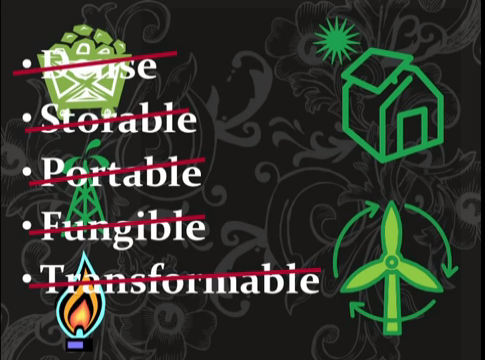
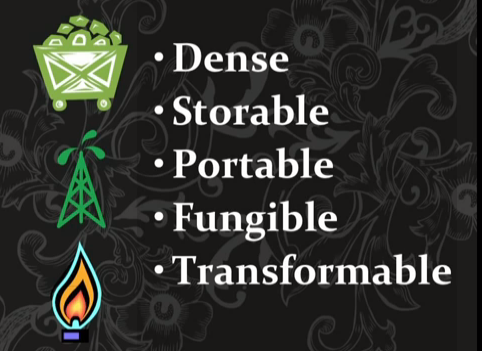
Now, I’m no fan of fossil fuels. Fossil fuels are finite and dirty, but we use them for five principal reasons. Fossil fuels are dense. Their energy is storable, portable, fungible (which means they can be easily traded), and they are transformable into other products like pesticides, fertilizers, and plastics.

Now, these qualities cannot be measured in kilowatts, so what happens when we spend our precious fossil fuels on building alternative energy. Well then we get energy that is not dense, but diffuse. It’s not easily storable. It’s not portable. It’s not fungible. And it is non-tranformable.

Now to increase the quality of the energy, we then have to spend more fossil fuels to build batteries, to build back-up power plants, and other infrastructure. And of course this is incredibly expensive. Ultimately that expense represents the hidden fossil fuels behind the scene.
There’s an impression that clean energy can supply a growing population of high consumers. There’s an impression that alternative energy can displace fossil fuel use, but the evidence doesn’t show that.»

La selva tiene más ojos que hojas

Si alguna vez creiste en la magia, no dejes de ver la charla de Antonio Donato Nobre sobre el Amazonas. 
La magia existe, está en la naturaleza, en lo que nos rodea, pero a base de insistir, la estamos haciendo desaparecer y convirtiendo nuestro mundo en un lugar gris, inhóspito, inhabitable y mucho menos bello de lo que fue.

(Está en brasileiro, recordad que hay una opción en youtube para poner subtítulos en varios idiomas)

Silvia Pérez Cruz y Raúl Fernández Miró

En Menorca, en el teatro principal de Mao, pude asistir al concierto de Silvia Pérez y Raúl Fernández presentando su disco ‘granada’, con g minúscula como la fruta; roja y blanca, ácida y dulce, suave y explosiva, así fue el concierto, una mecha para los sentidos. La voz inconfundible de Silvia Pérez, con un registro que sintoniza con los latidos del alma y el sintetizador de Raúl Fernández, con todo tipo de instrumentos de cuerda, que impregna de modernidad cada compás de la selección de canciones que reúne el disco.
De lo mejor del concierto, el pequeño vals vienes: música de Leonard Cohen y lírica de Federico García Lorca (take this waltz).
Para los que estén interesados, el 20 de Octubre 2014, tocan en el Teatro Nuevo Apolo de Madrid. 

Desigualdad, pobreza, ¿pueden erradicarse?

 
La ONU se enfrenta al difícil reto de redefinir la cooperación internacional, el modelo de ayuda al desarrollo que ha imperado hasta la fecha. Se mantienen, en diferentes ámbitos, reuniones para definir la agenda post-2015, ¿cómo erradicar la pobreza, la desigualdad, la exclusión social, las condiciones de vida infrahumanas?. La ONU ha abierto un proceso de participación ciudadana, las ideas de los movimientos sociales son bienvenidas, se busca aprender del pasado y poner sobre la mesa un nuevo enfoque. 
 
Creemos que es necesario deconstruir el sistema para reinventarlo por completo. El modelo de cooperación internacional nació auspiciado por la época post-descolonial, un momento histórico en el que el mundo occidental disfrutaba de una clara ventaja tecnológica, social y económica, frente al resto del mundo. A pesar de que las colonias desaparecieron, al menos en el papel, Occidente mantuvo su filosofía extractivista en todos aquellos países con recursos naturales o recursos humanos que le permitiesen continuar su carrera de expansión y crecimiento ilimitado. La cooperación internacional nace desde una perspectiva paternalista y demagoga en que se da por hecho que el modelo occidental es el bueno y cualquiera que no comparta los criterios occidentales debe ser ‘rehabilitado’ y ‘reprogramado’ en los arquetipos de progreso y desarrollo occidental para se considere que ha entrado en el buen camino. 
 
Estas políticas desarrollistas han facilitado la globalización y la pérdida de tradiciones y culturas milenarias en favor de un modelo único, de un mundo plano en el que la diversidad desaparece por minutos. Los mercados han crecido, los productos han barrido las fronteras y las grandes corporaciones han implantado sus procedimientos y sus modelos, acaparando la plusvalía y el tiempo de los ciudadanos, han empobrecido y endeudado a las comunidades, acopiado tierras, aguas y especulado con los recursos del procomún. La cooperación internacional y los gobiernos, que han promovido en las últimas décadas el crecimiento y desarrollo económico de los países más pobres, se encuentra ahora con una traslación de la riqueza, con una población de más de siete mil millones de personas que quiere vivir como los occidentales, con una huella ecológica insostenible, en un planeta finito que emana dolor a través de la acidificación de sus mares, de la muerte y desaparición de miles de especies, de la contaminación de su aire, del deterioro de la capa de ozono, de un proceso inabarcable de cambio climático, de un agotamiento masivo de sus recursos minerales, de la pérdida imparable de biodiversidad.
 
¿Vamos a seguir destinando fondos para que los países entren en la carrera del crecimiento económico, para que sean parte del mercado global, para que se incorporen nuevos consumidores, nueva mano de obra barata, nuevas presas fáciles del voraz endeudamiento? La cooperación debe reinventarse, el colectivo problemático no son los países pobres, sino el selecto y reducido grupo de propietarios que gracias a la desregulación de los gobiernos, han conseguido convertir en capital privado, recursos naturales que pertenecen a la Humanidad.
 
La agenda post-2015 debe abordar la necesidad imperiosa de modificar un sistema en el que no se da valor a todo lo que el actual modelo está exterminando y que no podrá ser repuesto en decenas de años, si es que alguna vez puede ser recuperado de algún modo. 
 
Es tiempo de dar un valor a los intangibles que hoy carecen de valor alguno. La invisibilidad económica de la naturaleza en el modelo actual, no sólo ha creado una brecha económica insalvable entre los países industrializados y los países ricos en recursos naturales, sino que ha generado una crisis medioambiental sin precedentes que debe ser revertida con urgencia, antes de que alcancemos el punto de no retorno, si es que no lo hemos alcanzado ya.
 
La naturaleza es riqueza y debe ser accesible por todas las comunidades y pueblos del mundo. Las corporaciones no pueden acaparar tierras y recursos naturales, desproveyendo a las comunidades más débiles y alejadas de las complejas estructuras post-industriales, no pueden continuar sentenciándolos a la pobreza y a la exclusión social en un modelo que no conocen y que no comparten. En palabras de Pavan Shukdev, ‘si perdemos la naturaleza, perdemos la oportunidad de solucionar la pobreza’.
 
La agenda post-2015 debería ofrecer una propuesta y un calendario de recuperación del procomún por los pueblos que han sido expoliados, así como un sistema de valoración de los intangibles que hoy emplean las grandes corporaciones a coste cero, en detrimento de las comunidades más pobres y expuestas a la exclusión económica y social.
 
La pobreza no se soluciona a partir de un modelo de crecimiento ilimitado porque no existen recursos suficientes en el planeta para que el PIB per capita mundial se asemeje al de USA o al de la media europea. El modelo actual funciona gracias a que el 20% de la población se beneficia y consume el 80% de los recursos mundiales; sin redistribución de los recursos, la pobreza no puede erradicarse, sin darle un valor a la naturaleza, al procomún, persistirá un modelo de expolio en el que las ayudas al desarrollo no serán más que limosnas y modelos de endeudamiento estatales y de los ciudadanos que perpetuarán el empobrecimiento de regiones completas y la devastación del planeta.
 
¿Cuál es el precio de la biodiversidad, del Amazonas sin talar, del aire limpio, de los recursos hídricos, de un aire no contaminado, de una tierra rica, no degradada por fertilizantes y pesticidas, el precio de la accesibilidad a las semillas, de la polinización natural? La agenda post-2015 debería primero valorar lo que hoy ni tan siquiera se contempla como un activo, para poder así establecer y diseñar un modelo justo y equitativo, un modelo sostenible en el tiempo y a lo largo de las generaciones, un modelo que reconozca los errores del pasado, repare las desigualdades creadas y restaure lo expoliado a las comunidades que han visto cómo les arrebataban su forma de vida y les lanzaban a la carrera del consumo y el crecimiento económico, sin más herramientas que el endeudamiento, el trabajo no cualificado para las grandes corporaciones y la ayuda internacional a través de los programas de cooperación.


nkali – how to dispossess people

Chimamanda Adichie talks about the risk of listening only to one version of a story.

Anchored in our western arrogance, we think we are greater and better than those that we call poor or underdeveloped. Maybe we should leave some arrogance behind and listen to what other cultures have to offer, to how other people live, far from the madness of growth and the western concept of prosperity.
One of the causes I support, which stands for a different perspective to help tribal peoples, to defend their lifes, to protect their lands and to determine their own futures, is Survival, who from a very sarcastic point of view has launched this video about North-South cooperation.

The Igbo people in Nigeria have a word, nkali, that roughly translates as being greater and better than another.

How come can we really think we are nkali?

Auto reciclaje

Todos producimos varias decenas de kilos de residuos plásticos al año. Por mucho que nos guste decir que reciclamos, lo cierto es que lo único que hacemos es separar en distintos contenedores que después inician el proceso de transporte, recuperación y por fin reciclado, para convertir lo separado en materias primas secundarias.
Ese proceso, además de caro, es mucha vez ineficiente y gran parte de nuestros residuos terminan, en el caso de España, en el vertedero y en las incineradoras en el resto de Europa o lo que es lo mismo, terminan convertidos en emisiones de CO2, en el mejor de los casos, y en el peor, en muchos otros gases de efecto invernadero que no sólo tienen un impacto negativo en el cambio climático, sino que además son tóxicos.
De alguna forma nos hemos desconectado de la realidad y ni siquiera pensamos en el problema que generamos al producir, comprar, consumir, tirar y volver a producir para comprar, consumir, tirar….
Sólo en España generamos al año 26 millones de toneladas de residuos domésticos, los llamados residuos urbanos que representan únicamente el 6% de todos los residuos generados en el país. Eso quiere decir, que su día a día, España genera cada año 433 millones de toneladas de residuos:: 433.000.000.000 kg.
Hay algunas iniciativas que promueven el auto reciclaje, más allá de las composteras que deberían venir de serie en las casas, igual que la caldera o el horno.
Una de las que más me gusta es la de Dave Hakkens que ha sido capaz de construir una planta de reciclaje adaptando máquinas que normalmente tienen otros usos.
Sin embargo creo que el futuro del auto reciclaje no vendrá de este tipo de garajes o hacker spaces, sino de la mano de impresoras 3D capaces de usar, como material para la impresión, los plásticos que desechamos como residuos.

Cuando el ánimo decae…

No puedo decir que no sea optimista, ni que no crea en mis ideas y persiga mis sueños, pero a veces después de dar muchas veces contra el mismo muro sin conseguir que se mueva ni un ápice… los ánimos caen y piensas que quizás el camino no debe ser ése porque hasta la fecha no has conseguido abrir más que la primera de las mil y una puertas, y pasa que cuando ya estás pensando en si mejor darte la vuelta, y echas un penúltimo vistazo, tras quitar algo de visceralidad, ves desde la distancia que del otro lado de la última puerta se empieza a congregar una multitud.

+ The vortex project
+ Parley for the oceans