The hacker economy

Many people assume that evolution is about the survival of the fittest. It’s not. What really drives evolution is adaptation to changing environments.
That’s why our planet is made up of more than just one super-fit organism. Instead, we have a complex ecosystem. New things come in and displace old ones, but the old ones tend to stick around somehow. Some have survived for millions of years.
We can imagine sharks and algae thumbing their nose. For all the newfangled organisms that have come along in the past million years, they still thrive. To them, not much has changed. Yet it surely has. In much the same way, as old industrial giants are just getting used to the knowledge and information economies, a new hacker economy is emerging.
The Craft Economy
The first consumer product was probably the Acheulean hand axe, the “killer app” of the Stone Age that enjoyed market dominance in Africa, Europe and Asia for more than a million years. It was simple and useful, made of accessible raw materials and easy to distribute and became the “killer app” of the prehistoric world.
People made it themselves, used it and then created a new one when it wore out or when they moved on to another place. Most of human history was like that, people made what they needed, sometimes got help from friends or family members, but were mostly self sufficient. There was some trade, but not much.
The craft economy was quaint, but incredibly inefficient. The lack of trade meant that people couldn’t specialize on what they did best or take time to come up with improvements. There was some advancement, but progress was incredibly slow.
The Industrial Economy
When James Watt invented the steam engine, he unleashed the industrial revolution. Human and animal muscle power would be multiplied by machines, making products that were cheaper and more uniform. Incomes rose dramatically.
Frederick Winslow Taylor then led the efficiency movement, which broke down processes to simple basic tasks and sought to constantly improve performance. Progress led to improvements in life conditions. Production in mass quantities lowered prices further which created more demand. A virtuous cycle ensued where more wealth led to more productivity.
Eventually, a new type of organization arose, the corporation. Alfred Sloan at General Motors perfected it by emulating the centralized and hierarchical setup of the military. Even greater mass production led to mass marketing and the consumer culture.
However, the industrial economy was drab and boring. Uniformity was the order of the day. It was the era of smokestacks and the man in the gray flannel suit.
The Knowledge Economy
While industrialization brought great strides and created enormous wealth, eventually it became clear that that creating efficiency is not the same as creating value. Businesses needed to innovate to increase productivity and stay ahead.
That led Peter Drucker to introduce the concept of the knowledge economy, where workers were not valued for their labor as much as they were for their expertise. Recognizing the shift, companies as diverse as McDonalds and General Electric invested heavily in corporate universities.
The knowledge economy was paired with two other trends: Decentralization and globalization. Workers who are valued for their expertise can’t be supervised in the same way as ordinary laborers, because they know things their managers don’t. Globalization made it possible to leverage that knowledge across many markets.
The Information Economy
Often confused with the knowledge economy, the information economy is profoundly different. While the industrial economy was primarily about moving around men and materiel and the knowledge economy helped to do so more productively, the information economy represented a shift from atoms to bits.
Just as machines multiplied muscle power, information technology augments intellectual power. Information, rather than knowledge possessed by an individual, is fungible. Today, however, we prize products that move information well. Google’s algorithms don’t cost any more to run than anybody else’s nor do they depend on special materials.
What’s special about the information economy is its ability to create accelerating returns. We routinely expect that our products will get exponentially better and cheaper all the time and, as the power of information expands, that trend is becoming increasingly present in industries ranging from healthcare to energy.
The next phase of the information economy will be digital-to-analog technologies like 3D printing and programmable matter, which transform information directly into physical products.
The Hacker Economy
The new economy that’s emerging now is the hacker economy, where brands become platforms rather than products. An iPhone is valuable not so much for the hardware, but for the apps created by third parties and, increasingly, those third parties are small entities or individuals.
The irony here is that the hacker economy is, in a very real sense, fostering a return to the craft economy. As Chris Anderson explains in his new book Makers, there is a large movement of people using open source technology to create their own products, although many are doing it for fun and enrichment rather than necessity.
And that’s what’s important. As economies evolve, choice expands. It is mass production, combined with knowledge and information, which has created such enormous wealth that we can choose our own possibilities.
Evolution, after all, thrives in niches.

P2P production and the coming of the commons

By Hilary Wainwright : Rethinking Michel Bauwens work.

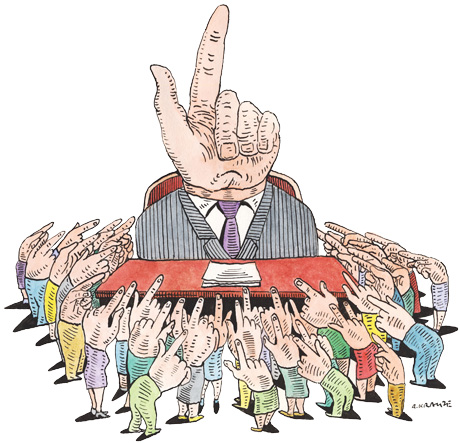
Illustration: Andrzej Krauze 
‘At a certain stage of development, the material productive forces of society come into conflict with the existing relations of production or – this merely expresses the same thing in legal terms – with the property relations within the framework of which they have operated hitherto. From forms of development of the productive forces these relations turn into their fetters. Then begins an era of social revolution. The changes in the economic foundation lead sooner or later to the transformation of the whole immense superstructure.’ 
Karl Marx, A Contribution to the Critique of Political Economy 
New words expressing new concepts usually indicate stirrings at other levels of reality. So when we read of widespread ‘peer-to-peer’ activity (sharing without central authorities) and the spread of ‘open source’ (the mutuality of creativity), or come across seemingly paradoxical concepts such as ‘produsers’ (users producing value as they use), or entirely new concepts such as ‘phyles’ (transnational networks of small companies in which the values of the commons are predominant), we should find out about the innovations that old language does not capture. 
We are witnessing the emergence of a new ‘proto’ mode of production based on distributed, collaborative forms of organisation. It is developing within capitalism, rather as Marx argued the early forms of merchant and factory capitalism developed within the feudal order. In other words system change is back on the agenda but in an unexpected form, not as a socialist alternative, but as a commons-based alternative. 
Capitalism in its present form is facing limits, especially resource limits, and in spite of the rapid growth of the BRICS (Brazil, Russia, India, China and South Africa) economies, is undergoing a process of decomposition. The question is whether the new proto-mode can generate the institutional capacity and the alliances able to break the political power of the old order. 
One way to describe the changes now taking place is as a shift away from a context in which the technological and economic advantage lies with economies of scale and mass production that depend on cheap global transportation and, thus, the continuous availability of fossil fuels. The move is to ‘economies of scope’, where bringing down the cost of common infrastructure for networked enterprises brings competitive advantages. 
It is in achieving these economies of scope that the distributed, peer-to-peer forms of production made possible by new information and communication technologies can be deployed. 
Distributed production: who has control? 
The ecological and resource scarcity crisis makes the shift to economies of scope seem all but inevitable. Such a shift takes two major forms: the mutualising of knowledge, which is the ‘open source’ model; and the mutualisation of physical resources, which takes the form of ‘collaborative consumption’ in order to mobilise idle resources. Both occur in the greater context of the horizontalisation of human communication and the common value creation that have been enabled with the internet. These involve forms of mutual accommodation between centralised institutions (such as corporations and states) and decentralised, interconnected productive publics (such as open source software producers and social network users). In such accommodations there is a clear divide between those contexts where control is firmly vested in the companies, and is disadvantageous to the workers/producers, and forms in which the community dynamics remain dominant, and institutions have to adapt to the rules and norms of a community. 
In the sphere of immaterial production, Facebook and Google are representative of forms in which individuals share their expressive output but do not collaborate with each other on common objects. Typically, such platforms will use business models that do not return the value to the users who have actually created it. 
Commons-based peer production, by contrast, is emerging as a proto-mode of production in which the value is created by productive publics or ‘produsers’ in shared innovation commons, whether they are of knowledge, code or design. It occurs wherever people can link up horizontally and without permission to create common value together. It has the most potential as a leverage to transform what is now a proto-mode of production into a real mode of production beneficial to workers and ‘commoners’. To achieve this, strategic and tactical breaks with capitalism are necessary, though not necessarily with market forms. 
How does commons-based peer production work? 
Generalising from practice in the sphere of immaterial production, the new system functions as follows. 
The contributors are either volunteers, or paid employees of collaborating companies. The infrastructure of cooperation is often maintained by a new type of ‘for-benefit’ association, such as the Wikimedia Foundation, which oversees Wikipedia, or the so-called FLOSS (Free/Libre and Open Source Software) Foundations such as the Apache Foundation, which provides organisational, legal, and financial support for software that powers much of the web. 
These foundations do not command and control the labour of production but enable and empower its emergence and the social allocation of resources by the associated producers. Around these commons, we see the emergence of entrepreneurial coalitions. These consist of enterprises that create market value ‘on top of the commons’. 
An example here would be the open source provider Red Hat, which distributes and supports a commercial version of the free Linux operating system. Their role in the feedback loop of value creation consists in making possible the individual social reproduction of the commoners/contributors, and often sustaining the for-benefit associations that also act as buffer between the community of peer producers and the entrepreneurs. 
This new emerging modality tends to out-cooperate and out-compete classic modes of capitalist production. This is because of its higher innovation potential (there is no privatisation of innovation); the ability for distributed parallel development on a global scale without the use of costly bureaucracies of control (as with Wikipedia, every module can be worked on separately, by any contributor with the necessary skills); and the much cheaper production costs due to price structures free of the rent of ‘intellectual property’ (IP). Where these new forms occur – in knowledge production, free software production and now emerging in physical production – they tend to displace proprietary and IP-based modes. A study by the Computer and Communications Industry Association estimates that the US ‘fair use’ economy, based on shared, ‘balanced copyright’ knowledge, already employs 17.5 million people and accounted for one sixth of GDP in 2007. 
Replacing capitalism? 
As with the proto-capitalist modes under feudalism, today’s new forms co-exist with the dominant modality and may at first even strengthen it. In peer production today, the individual workers are still employed by capital – but at the same time the role of the commons and the community, and its explicitly co-operative, non‑capitalist logic, is a core aspect of the new organisation of production. Peer producers are knowledge workers and an integral part of the working class, while the entrepreneurial coalition is often dominated by a ‘netarchical’ capitalist class – a new category of capitalist that is no longer dependent on the ownership of IP rights but rather on the development and control of participatory platforms such as Facebook. This netarchical class knows how to capture value out of social production for the benefit of capital. 
The new mode of peer production has features that prefigure a new productive system in the sense that the sharing of knowledge, code or design essentially follows a logic similar to communism as described by Marx: anyone can contribute, and anyone with access to the network can access the resource. Resources are allocated socially, through the decisions of the contributors to allocate their skills and energy to a particular part of the project. The solutions are added back to the same commons, and can be used by all, even where they have been created by developers who are also employees of capitalist companies. 
The paradox, of course, is that this really-existing communism is interdependent with the really-existing capitalism of the entrepreneurial coalition that works with that particular commons. This makes the transitional mode of peer production a new terrain of social tension, struggle and, eventually, adaptation between various social forces. 
Ultimately, the potential of the new mode is the same as those of previous proto-modes of production – to emancipate itself from its dependency on the old decaying mode, so as to become self-sustaining and thus replace the ‘circulation of capital’ with an independent ‘circulation of the common’. In a circulation of the common, the value that is created by the commoners for the commons would directly contribute to the further strengthening of the commons, without dependence on capital. How could this be achieved? 
Critically, it would require an amendment of the existing sharing licenses, to prevent the value capture (without retribution) of capital – for example, the use of the ‘peer production’ or ‘copy-far-left’ licence, as proposed by Dmytry Kleiner and chosen by the P2P Foundation. 
Our proposal is that the users of the commons should be commons-friendly enterprise structures and not profit-maximising companies. These ethical companies, whose members are the commoners/contributors themselves, would be organised as global open design companies. These would be linked to networks of small factories that produce on the basis of shared values and could more easily adopt open-book management, open recruiting and open supply lines, ensuring transparency to the whole network, in order to create maximum mutual alignment between participants. This is simply an extension of the existing organisational practices of ‘immaterial commons production’, which combines full transparency of all actions with negotiated coordination. 
In order to turn peer production from a transitional mode within capitalism to a potential new dominant mode of production, we have to bring together the commonist aspects of immaterial cooperation with manufacturing companies that do not reward shareholders and owners of capital but rather the value creators themselves. By interconnecting these emerging players we will create a powerful seed form for the future. 
One possible way of doing so is through a conversion of the existing social/solidarity economy towards shared innovation commons. If social economy actors adopted shared innovation commons, they would become hyper-cooperative, and hence effectively competitive with multinational corporations, which they would outperform in terms of speed and depth of innovation, as well as price, since they would operate without intellectual property mark-ups. From what Marx called ‘dwarfish forms’, they would transform into powerful global players. 
How does this apply to manufacturing? 
A corporate-driven move to distributed forms of production has been underway for some time. When this ‘classic’ distributed manufacturing is coupled with the principle of shared innovation commons – that is, as the distributed production of ‘open hardware’ – much more dramatic changes could be afoot. Marcin Jakubowski of the Open Source Ecology project, which develops about 50 types of open hardware-based production machinery (open source tractors, bricklaying machines and so on), and Wikispeed, the open source car project, have announced the development of an ‘extreme manufacturing’ platform. 
We regard this as the peer production equivalent of the invention of the assembly line by Henry Ford. It inserts the rapid production methodologies that have proven themselves in open source software production (such as ‘extreme programming’) into the world of machine design, and links it directly to microfactories and distributed enterprise. 
As Jakubowski explains this model, it directly addresses the issue of economies of scope by offering a globally mutualised production infrastructure: ‘Extreme Manufacturing (XM) is an open source hardware development methodology, which focuses open source design and collaboration, and the revenue model is distributive enterprise . . . The magic of this method lies in synergistic, lively, distributed, parallel development.’ He explains how it is lean in its organisation but ‘maintains sufficient structure for scalability’. 
This sort of distributed system can operate within a capitalist framework but can also, when linked with shared innovation commons, provide a new form of open and distributed manufacturing centred on social, rather than profit-driven, value creation. The bases for an integrated distributed manufacturing system are currently under rapid development. They include distributed access to machinery: 3D printing and other forms of personal fabrication, such as currently developed in FabLabs and hackerspaces, as well as in emerging microfactory models such as Wikispeed and Local Motors. 
It requires distributed access to physical places for collaboration – co-working centres – as well as the widespread possibility for peer learning. Distributed access to financial capital is a further condition, notably crowd-funding, social lending and distributed, decentralised currencies such as cryptography-based digital money Bitcoin. The spread of these peer to peer forms of funding has already attracted the attention of the Bank of England executive director, Andrew Haldane, who has suggested that peer to peer finance models could sweep away the inefficient retail banks before too long. 
Access to distributed forms of energy and raw materials will also be fundamental. Here too there are established trends in this direction. For instance, half of Germany’s solar energy is produced by community‑owned local cooperatives. The availability of appropriate legal forms to allow for entrepreneurship in this new modality will be necessary. 
If it is true that the capitalist mode of production is reaching its limits, and that this emerging new mode of value creation creates significant opportunities for commons-centred production, then we need to seize this opportunity – not just at the micro-level as a new social practice, but as a societal project for emancipation. 
How would peer production be extended to the whole of society?
The current capitalist system is based on two entirely erroneous premises: first, that nature is abundant and can be infinitely exploited to obtain endless growth; and second, that sharing of innovation, culture and science should be hampered through privatisation of intellectual property – an imposition of artificial scarcity. These macro-economic principles are then written into the ‘constitutions’ of profit-maximising corporations, which are legally obliged to enrich their shareholders by maximising social and environmental externalities. 
Peer production models show us a new possible reality in which the democratic civic sphere, productive commons and a vibrant market can co-exist for mutual benefit. This model has three dimensions. At the core of value creation are various commons, where innovations are deposited for all humanity to share and build on. 
These commons are facilitated and protected through non-profit civic associations, with the ‘partner state’ as their territorial equivalent, empowering and enabling that social production. Around the commons emerges a vibrant economy undertaken by different kinds of ethical companies, whose legal structures tie them to the values and goals of the commons communities, not absentee and private shareholders’ intent of maximising profit at any cost. 
Where the three circles intersect, there are the citizens deciding on the optimal shape of their provisioning systems. This is what happened when the counter-power structure of Occupy Wall Street in New York decided to complement its free provisioning of food with the Street Vendor Project, enabling supporters to buy food from local street vendors. This was a conscious, citizen-driven choice for an ethical economy subsumed under the citizenry and its political commons. Occupy and the indignados signify the birth of digital-native social movements, and a necessary politicisation around the new productive and social possibilities. 
While the shift to distributed production may be inevitable, the form it takes is open to evolution. This will be determined not just by the social construction of alternatives, in which communities, corporations and the state intersect, but also by outright social struggle, including in the field of political representation. 
A political expression of the commons 
New social movements always start first as a new subculture, consisting of people who invent new social practices. The file sharing communities at the root of the Swedish Pirate Party initially consisted simply of music lovers who wanted to share their music and discoveries. These communities discovered that such sharing was actually illegal, because the laws still attached to intellectual property do not give the user sovereignty over their acquired material but subject it to a prohibition on sharing, in order to ensure a guaranteed rent income to entertainment corporations. 
At first, such communities did not directly attack the system that repressed their freedom to share. Instead they started building their own infrastructure. This included the new type of creative commons and other ‘copyleft’ licenses that formalise the right to share. 
However, there is a stage in the evolution of a new social movement and culture when political power is crucial to ensure its survival and development. It is not enough to create new institutions on the margins of society; effective defence mechanisms against the constant attacks of the dominant powers become a necessity. This means building a political coalition. 
The Pirate parties, one of which is expected to carry 10 per cent of German voters in the next election, are the first political expression of free culture. The Pirates are the natural defenders of the digital commons at the heart of the new mode of production. Sociologically, they attract the votes of the precarious youth generations that are most involved in the new productive modalities. 
The Greens and ecological parties also claim to be the natural defenders of the commons. They are often the parties of choice of older, highly educated, knowledge workers. 
The left and social justice parties, some of which have made significant gains in recent elections in in Europe, are of course parties of the productive commons. They could be a force that understands the advantages of distributed production that can be accessed and owned by the workers-producers themselves. They often receive the votes of government employees and industrial workers who are still loyal to the older labour traditions. 
A final element in a new political coalition would consist of progressive liberal forces. For example, in Denmark, culture minister Uffe Elbaek is known for his commons-friendly approach. Such parties can represent a link with socially progressive entrepreneurs who create enterprises around the commons. 
From these diverse roots, a new progressive majority can be created around free culture, respect for nature and its limits, the necessity of social justice and ethical entrepreneurship. This ‘grand coalition of the commons’ can create a new political majority for social change. 
While none of the parties involved is as yet quite ready for it, a convergence of commons-friendly forces could create the conditions for a new social hegemony that could challenge the current dominant players and potentially re-arrange both peer production and a commons-centred society, so that it is driven by the commoners and operates in their interest. 

The creativity of labour

Hilary Wainwright poses some questions about how to achieve a commons-based alternative to capitalist production 
he work of Michel Bauwens and the P2P Foundation on a peer to peer/commons approach to production is important for several reasons. First, it draws attention to the fact that the new information, design and communication technologies make possible economies of co-ordination and transaction that provide potentially historic opportunities for scaling up, spreading and expanding the many dispersed economic initiatives driven by social values rather than profit maximisation. 
Bauwens identifies this potential in the full knowledge that these same technologies enable the canniest corporations to become increasingly powerful while at the same time minimising their costs. Distributed, decentralised production is for Bauwens a contested terrain, full of ambivalences and risks as well as opportunities for transformative politics. 
The second reason for the importance of his work is his focus on the growth of a commons of knowledge and design, in both immaterial and increasingly material production, as a development of immense strategic significance and with an already transformative character. In itself this commons is no island of unalienated work, however. Take open software development, for example: the success of Apple, Google and IBM is based on a business model, as Bauwens implies, that gives these companies access to creative labour while leaving responsibility for productivity with the developers themselves. In doing so, they avoid incurring the costs of recruitment, training, pensions, childcare leave or other means of sustaining labour. 
Bauwens claims to provide a complete design for a new model of production: ownership, management structure, distribution system and all. His strength is his specific focus on the knowledge and design commons but at the same time an openness to the wider connections that will help realise its transformative potential . 
Some questions, then, from a sympathetic point of view, to help to take the argument further. First, if the most intelligent predator companies are already exploiting commons production, what is to stop the corporations from fencing this commons in? What wider connections to what countervailing forces, initiatives and sources of support could enable this commons to contribute to a wider challenge to the capitalist firms? 
I’m thinking here of connections within the economy, as distinct from – but not opposed to – the kind of political alliance that Bauwens interestingly but a little optimistically sketches. For example, what possibilities are there of linking up with and strategically enhancing the co-operative and solidarity economy discussed by Robin Murray and others in the previous issue of Red Pepper
Is there a role for the unions in developing such an alternative? Levels of unionisation are low among IT workers. Open software developers, though, have a variety of strong networks of their own that act as sources of recognition and employment, and provide a degree of protection, bargaining power and sometimes a basis for campaigning on issues of common concern – for example, in opposition to attempts to impose proprietary enclosures. Could unions learn from experiences of supporting organisations of the self-employed, such as Streetnet in South Africa and Sewa in India, or from other unions such as the National Union of Journalists that have supported freelance workers for a long time? How would unions have to change to make the issues of control over the use and purpose of human creativity as important as the struggle over employment conditions and payment? Would it help to see labour as human creativity as itself a commons? 
It would lead to asking: what are the institutional, including financial, conditions for nurturing and realising the creativity of each for the benefit of all? This would apply at micro levels – how enterprises should be organised – and at the macro. What means of livelihood, with what public support, would be required to have some autonomy from the labour market? What legislative frameworks would be needed; what support for education, training, sabbaticals? And how can we envisage non-capitalist market forms that can be experimented with here and now as part of the contestation and competition with capitalist forms? 
Above all, though, as the left shows tentative signs of electoral recovery, we must learn the lesson of how social democracy has been bulldozed or captured by corporate power. This is in no small part due to the fact that its programmes of redistribution were not rooted in a distinct strategy for production, with the creativity and solidarity of labour at its centre. Bauwens offers an opportunity for thinking and acting over production beyond capitalism. We should grasp it in all its complexity.

The end of an era

Authored by Dr. Tim Morgan, Tullet Prebon,

The economy as we know it is facing a lethal confluence of four critical factors – the fall-out from the biggest debt bubble in history; a disastrous experiment with globalisation; the massaging of data to the point where economic trends are obscured; and, most important of all, the approach of an energy-returns cliff-edge.
Through technology, through culture and through economic and political change, society is more short-term in nature now than at any time in recorded history. Financial market participants can carry out transactions in milliseconds. With 24-hour news coverage, the media focus has shifted inexorably from the analytical to the immediate. The basis of politicians’ calculations has shortened to the point where it can seem that all that matters is the next sound-bite, the next headline and the next snapshot of public opinion. The corporate focus has moved all too often from strategic planning to immediate profitability as represented by the next quarter’s earnings.
This report explains that this acceleration towards ever-greater immediacy has blinded society to a series of fundamental economic trends which, if not anticipated and tackled well in advance, could have devastating effects. The relentless shortening of media, social and political horizons has resulted in the establishment of self-destructive economic patterns which now threaten to undermine economic viability. We date the acceleration in short-termism to the early 1980s.
Since then, there has been a relentless shift to immediate consumption as part of something that has been called a “cult of self-worship”. The pursuit of instant gratification has resulted in the accumulation of debt on an unprecedented scale. The financial crisis, which began in 2008 and has since segued into the deepest and most protracted economic slump for at least eighty years, did not result entirely from a short period of malfeasance by a tiny minority, comforting though this illusion may be. Rather, what began in 2008 was the denouement of a broadly-based process which had lasted for thirty years, and is described here as “the great credit super-cycle”.
The credit super-cycle process is exemplified by the relationship between GDP and aggregate credit market debt in the United States (see fig. 1.1). In 1945, and despite the huge costs involved in winning the Second World War, the aggregate indebtedness of American businesses, individuals and government equated to 159% of GDP. More than three decades later, in 1981, this ratio was little changed, at 168%. In real terms, total debt had increased by 214% since 1945, but the economy had grown by 197%, keeping the debt ratio remarkably static over an extended period which, incidentally, was far from shock-free (since it included two major oil crises).
From the early 1980s, as figs. 1.1 and 1.2 show, an unmistakeable and seemingly relentless upwards trend in indebtedness became established. Between 1981 and 2009, debt grew by 390% in real terms, far out-pacing the growth (of 120%) in the American economy. By 2009, the debt ratio had reached 381%, a level unprecedented in history. Even in 1930, when GDP collapsed, the ratio barely topped 300%, and thereafter declined very rapidly indeed.
This report is not, primarily, about debt, and neither does it suggest that the problems identified here are unique to the United States. Rather, the massive escalation in American indebtedness is one amongst a host of indicators of a state of mind which has elevated immediate consumption over prudence throughout much of the world.
This report explains that we need only look beyond the predominant short-termism of contemporary thinking to perceive that we are at the confluence of four extremely dangerous developments which, individually or collectively, have already started to throw more than two centuries of economic expansion into reverse.
Before the financial crisis of 2008, this analysis might have seemed purely theoretical, but the banking catastrophe, and the ensuing slump, should demonstrate that the dangerous confluence described here is already underway. Indeed, more than two centuries of near-perpetual growth probably went into reverse as much as ten years ago.
Lacking longer-term insights, today’s policymakers seem bewildered about many issues. Why, for instance, has there been little or no recovery from the post-2008 economic slump? Why have traditional, tried-and-tested fiscal and monetary tools ceased to function? Why have both austerity and stimulus failed us?
The missing piece of the economic equation is an appreciation of four underlying trends, each of which renders many of the lessons of the past irrelevant.
trend #1 – the madness of crowds
The first of the four highly dangerous trends identified here is the creation, over three decades, of the worst financial bubble in history. In his 1841 work Extraordinary Popular Delusions and the Madness of Crowds, Charles Mackay (1814-89) identified a common thread of individual and collective idiocy running through such follies of the past as alchemy, witchhunts, prophecies, fortune-telling, magnetizers, phrenology, poisoning, the admiration of thieves, duels, the imputation of mystic powers to relics, haunted houses, crusades – and financial bubbles.
A clear implication of Mackay’s work was that all of these follies had been consigned to the past by intelligence, experience and enlightenment. For the most part, he has been right. Intelligent people today do not put faith in alchemy, fortune-telling, witchcraft or haunting, and – with the arguable exception of the invasion of Iraq – crusades have faded into the history books.
But one folly remains alive and well. Far from confining financial bubbles to historical tales of Dutch tulips and British South Sea stock, the last three decades have witnessed the creation and the bursting of the biggest bubble in financial history.
Described here as ‘the credit supercycle’, this bubble confirmed that one aspect, at least, of the idiocy identified by Mackay continues to wreak havoc. Insane though historic obsessions with tulip bulbs and south seas riches may appear, they are dwarfed by the latterday, ‘money for nothing’ lunacy that, through the credit super-cycle, has mired much of the world in debts from which no escape (save perhaps hyperinflation) exists.
Perhaps the most truly remarkable feature of the super-cycle was that it endured for so long in defiance of all logic or common sense. Individuals in their millions believed that property prices could only ever increase, such that either borrowing against equity (by taking on invariably-expensive credit) or spending it (through equity release) was a safe, rational and even normal way to behave.
Regulators, meanwhile, believed that there was nothing wrong with loosening banking reserve criteria (both by risk-weighting assets in ways that masked leverage, and by broadening definitions of bank capital to the point where even some forms of debt counted as shock-absorbing equity).
Former Federal Reserve boss Alan Greenspan has been ridiculed for believing that banks would always act in the best interests of their shareholders, and that the market would sort everything out in a benign way. Butregulators more generally bent over backwards to ignore the most obvious warning signs, such as escalating property price-to-incomes ratios, soaring levels of debt-to-GDP, and such obviously-abusive practices as sub-prime mortgages, NINJA loans and the proliferation of unsafe financial instruments.
Where idiocy and naïveté were concerned, however, regulators and the general public were trumped by policymakers and their advisors. Gordon Brown, for example, proclaimed an end to “boom and bust” and gloried in Britain’s “growth” despite the way in which debt escalation was making it self-evident that the apparent expansion in the economy was neither more nor less than the simple spending of borrowed money.
Between 2001-02 and 2009-10, Britain added £5.40 of private and public debt for each £1 of ‘growth’ in GDP (fig. 1.3). Between 1998 and 2012, real GDP increased by just £338bn (30%) whilst debt soared by £1,133bn (95%) (fig. 1.4).
Asset managers have a very simple term to describe what happened to Britain under Brown – it was a collapse in returns on capital employed.
No other major economy got it quite as wrong as Britain under Brown, but much the same was happening across the Western world, most notably in those countries which followed the disastrous Anglo-American philosophy of “light-touch” financial regulation.
trend #2 – the globalisation disaster
The compounding mistake, where the Western countries were concerned, was a wide-eyed belief that ‘globalisation’ would make everyone richer, when the reality was that the out-sourcing of production to emerging economies was a self-inflicted disaster with few parallels in economic history. One would have to look back to a Spanish empire awash with bullion from the New World to find a combination of economic idiocy and minority self-interest equal to the folly of globalization.
The big problem with globalisation was that Western countries reduced their production without making corresponding reductions in their consumption. Corporations’ outsourcing of production to emerging economies boosted their earnings (and, consequently, the incomes of the minority at the very top) whilst hollowing out their domestic economies through the export of skilled jobs.
This report uses a measure called ‘globally-marketable output’ (GMO) as a metric for domestic production, a measure which combines manufacturing, agriculture, construction and mining with net exports of services. By definition, activities falling outside this category consist of services provided to each other.
At constant (2011) values, consumption by Americans increased by $6,500bn between 1981 and 2011, whilst consumption on their behalf by the government rose by a further $1,700bn, but the combined output of the manufacturing, construction, agricultural and extractive industries grew by barely $600bn. At less than $200bn in 2011, net exports of services did almost nothing to bridge the chasm between consumption and production.
This left two residuals – domestically consumed services, and debt – with debt the clincher. Between 1981 and 2011, and again expressed at constant values, American indebtedness soared from $11 trillion to almost $54 trillion.
Fundamentally, what had happened here was that skilled, well-paid jobs had been exported, consumption had increased, and ever-greater quantities of debt had been used to fill the gap. This was, by any definition, unsustainable. Talk of Western economies modernising themselves by moving from production into services contained far more waffle than logic – Western consumers sold each other ever greater numbers of hair-cuts, ever greater quantities of fast food and ever more zero-sum financial services whilst depending more and more on imported goods and, critically, on the debts used to buy them. Corporate executives prospered, as did the gateholders of the debt economy, whilst the vast majority saw their real wages decline and their indebtedness spiral. For our purposes, what matters here is that reducing production, increasing consumption and taking on escalating debt to fill the gap was never a remotely sustainable course of action. What this in turn means is that no return to the pre-2008 world is either possible or desirable.
trend #3 – an exercise in self-delusion
One explanation for widespread public (and policymaker) ignorance of the truly parlous state of the Western economies lies in the delusory nature of economic and fiscal statistics, many of which have been massaged out of all relation to reality.
There seems to have been no ‘grand conspiracy’ here, but the overall effect of accretive changes has been much the same. In America, for example, the benchmark measure of inflation (CPI-U) has been modified by ‘substitution’, ‘hedonics’ and ‘geometric weighting’ to the point where reported numbers seem to be at least six percentage points lower than they would have been under the ‘pre-tinkering’ basis of calculation used until the early 1980s. US unemployment, reported at 7.8%, excludes so many categories of people (such as “discouraged workers”) that it hides very much higher levels of inactivity.
The critical distortion here is clearly inflation, which feeds through into computations showing “growth” even when it is intuitively apparent (and evident on many other benchmarks) that, for a decade or more, the economy has, at best, stagnated, not just in the United States but across much of the Western world. Distorted inflation also tells wage-earners that they have become better off even though such statistics do not accord with their own perceptions. It is arguable, too, that real (inflation-free) interest rates were negative from as long ago as the mid-1990s, a trend which undoubtedly exacerbated an escalating tendency to live on debt.
Fiscal figures, too, are heavily distorted, most noticeably in the way in which quasi-debt obligations are kept off the official balance sheet. As we explain in this report, the official public debts of countries such as the United States and the United Kingdom exclude truly enormous commitments such as pensions.
trend #4 – the growth dynamo winds down
One of the problems with economics is that its practitioners preach a concentration on money, whereas money is the language rather than the substance of the real economy. Ultimately, the economy is – and always has been – a surplus energy equation, governed by the laws of thermodynamics, not those of the market.
Society and the economy began when agriculture created an energy surplus which, though tiny by later standards, liberated part of the population to engage in non-subsistence activities.
A vastly larger liberation of surplus energy occurred with the discovery of the heat engine, meaning that the energy delivered by human labour could be leveraged massively by exogenous sources of energy such as coal, oil and natural gas. A single US gallon of gasoline delivers work equivalent to between 360 and 490 hours of strenuous human labour, labour which would cost perhaps $6,500 if it were paid for at prevailing rates. Of the energy – a term coterminous with ‘work’ – consumed in Western societies, well over 99% comes from exogenous sources, and probably less than 0.7% from human effort. Energy does far more than provide us with transport and warmth. In modern societies, manufacturing, services, minerals, food and even water are functions of the availability of energy. The critical equation here is not the absolute quantity of energy available but, rather, the difference between energy extracted and energy consumed in the extraction process. This is measured by the mathematical equation EROEI (energy return on energy invested).
For much of the period since the Industrial Revolution, EROEIs have been extremely high. The oil fields discovered in the 1930s, for example, provided at least 100 units of extracted energy for every unit consumed in extraction (an EROEI of 100:1). For some decades now, though, global average EROEIs have been falling, as energy discoveries have become both smaller and more difficult (meaning energy-costly) to extract.
The killer factor is the non-linear nature of EROEIs. As fig. 1.5 shows, the effects of a fall-off in EROEI from, say, 80:1 to 20:1 do not seem particularly disruptive but, once returns ratios have fallen below about 15:1, there is a dramatic, ‘cliff-edge’ slump in surplus energy, combined with a sharp escalation in its cost.
Research suggests that the global average EROEI, having fallen from about 40:1 in 1990 to 17:1 in 2010, may decline to just 11:1 by 2020, at which point energy will be about 50% more expensive, in real terms, than it is today, a metric which will carry through directly into the cost of almost everything else – including food.
crisis, culpability and consequences
If the analysis set out in this report is right, we are nearing the end of a period of more than 250 years in which growth has been ‘the assumed normal’. There have been setbacks, of course, but the near-universal assumption has been that economic growth is the usual state of affairs, a rule to which downturns (even on the scale of the 1930s) are the exceptions. That comfortable assumption is now in the process of being over-turned.
The views set out here must provoke a host of questionsFor a start, if we really are nearing a cliff-edge economic crisis, why isn’t this visible already? Second, who is to blame for this? Third, how bad could it get? Last, but surely most important, can anything be done about it?
Where visibility is concerned, our belief is that, if the economy does tip over in the coming few years, retrospect – which always enjoys the 20-20 vision of hindsight – will say that the signs of the impending crash were visible well before 2013.
For a start, anyone who believed that a globalisation model (in which the West unloaded production but expected to consume as much, or even more, than ever) was sustainable was surely guilty of wilful blindness. Such a state of affairs was only ever viable on the insane assumption that debt could go on increasing indefinitely. Charles Mackay chronicled many delusions, but none – not even the faith placed in witchcraft – was ever quite as irrational as the belief (seldom stated, but always implicit in Western economic policy) that there need never be an end to a way of life which was wholly dependent on ever-greater debt.
Even to those who were happy to swallow the nonsense of perpetually expanding indebtedness, the sheer scale of debt – and, relevantly in this context, of quasi-debt commitments as well – surely should have sounded  warning bells. From Liverpool to Los Angeles, from Madrid to Matsuyama, the developed world is mired in debts that can never be repaid. In addition to formal debt, governments have entered into pension and welfare commitments which are only affordable if truly heroic assumptions are made about future prosperity.
At the same time, there is no real evidence that the economy is recovering from what is already a more prolonged slump than the Great Depression of the 1930s. We are now more than four years on from the banking crisis and, under anything approaching normal conditions, there should have been a return to economic expansion by now. Governments have tried almost everything, from prolonged near-zero interest rates and stimulus expenditures to the creation of money on a gigantic scale. These tools have worked in the past, and the fact that, this time, they manifestly are not working should tell us that something profoundly different is going on.
The question of culpability has been the equivalent of Sherlock Holmes’ “dog that did not bark in the night”, in that very few individuals have been held to account for what is unarguably the worst economic disaster in at least eighty years. A small number of obviously-criminal miscreants have been prosecuted, but this is something that happens on a routine basis in normal times, so does not amount to an attribution of blame for the crisis. There has been widespread public vilification of bankers, the vast majority of whom were, in any case, only acting within the parameters of the ‘debtfuelled, immediate gratification’ ethos established across Western societies as a whole.
Governments have been ejected by their electorates, but their replacements have tended to look very similar indeed to their predecessors. The real reason for the seeming lack of retribution is that culpability is far too dispersed across society as a whole. If, say, society was to punish senior bankers, what about the thousands of salesmen who knowingly pushed millions of customers into mortgages that were not remotely affordable? The suspicion lingers that there has been a ‘grand conspiracy of culpability’, but even the radical left has failed to tie this down to specifics in a convincing way.
The real causes of the economic crash are the cultural norms of a society that has come to believe that immediate material gratification, fuelled if necessary by debt, can ever be a sustainable way of life. We can, if we wish, choose to blame the advertising industry (which spends perhaps $470bn annually pushing the consumerist message), or the cadre of corporate executives who have outsourced skilled jobs in pursuit of personal gain. We can blame a generation of policymakers whose short-termism has blinded them to underlying trends, or regulators and central bankers who failed to “take away the punch-bowl” long after the party was self-evidently out of control.
But blaming any of these really means blaming ourselves – for falling for the consumerist message of instant gratification, for buying imported goods, for borrowing far more than was healthy, and for electing glib and vacuous political leaders.
Beyond visibility and culpability, the two big questions which need to be addressed are ‘how bad can it get?’ and‘is there anything that we can do about it?’
Of these, the first question hardly needs an answer, since the implications seem self-evident – economies will lurch into hyper-inflation in a forlorn attempt to escape from debt, whilst social strains will increase as the vice of resource (including food) shortages tightens. In terms of solutions, the first imperative is surely a cultural change away from instant gratification, a change which, if it is not adopted willingly, will be enforced upon society anyway by the reversal of economic growth.
The magic bullet, of course, would be the discovery of a new source of energy which can reverse the winding-down of the critical energy returns equation. Some pin their faith in nuclear fusion (along lines being pioneered by ITER) but this, even if it works, lies decades in the future – that is, long after the global EROEI has fallen below levels which will support society as we know it. Solutions such as biofuels and shales are rendered non-workable by their intrinsically-low EROEIs.
Likewise, expecting a technological solution to occur would be extremely unwise, because technology uses energy – it does not create it. To expect technology to provide an answer would be equivalent to locking the finest scientific minds in a bankvault, providing them with enormous computing power and vast amounts of money, and expecting them to create a ham sandwich.
In the absence of such a breakthrough, really promising energy sources (such as concentrated solar power) need to be pursued together, above all, with social, political and cultural adaptation to “life after growth”.
Ecovillages

Robert Gilman set out a definition of an ecovillage that was to become a standard:
«human-scale full-featured settlement in which human activities are harmlessly integrated into the natural world in a way that is supportive of healthy human development, and can be successfully continued into the indefinite future.»
You can find a couple of directories of different types of communities
Top 10 eco-communities around Europe shown in the documentary ‘A new we
  1. Sieben Linden (Germany-120 residents)
  2. Krishna Valley (Hungary – 150 residents)
  3. Schloss Tonndorf (Germany)
  4. Damanhur (Italy -1.000 residents)
  5. Schloss Glarisegg (Switzerland)
  6. Finca Tierra (La palma, Canary Islands – Spain)
  7. La Borie Noble (France – 100 residents)
  8. Tamera (Portugal – 160 residents)
  9. Valle de sensaciones (Alpujarras, Spain)
  10. Matavenero (Montes de León, Spain – 40 residents)

Sharing communities

This is not the first time I talk about collaborative consumption and I am sure it will not be the last. This movement is growing as the same pace as the sharing phylosophy; the most we can use anything we own, the best for the planet and a highest return for our investment. Economies of scale do not only apply to the big companies but also to the communities, join with others to be stronger, share your knowledge, share your belongings, be part of a community and enjoy the stregth of working together with people with your same concerns.
An overview of the top sharing communities
+ OuiShare – Creative community for the collaborative economy
+ Share Tompkins – Helps folks to share and trade goods in Tompkins, NY
+ Squared NY – Several S2NY organizations
+ Consumo colaborativo – Digital media platform to spread information and best practices to the sharing community, based in Spain
+ Unstash –  Peer-to-peer platform for collaborative consumption
And a great article with the main collaborative consumption projects world wide, can be found here.