Graywater – Grow with the flow

As many regions’ water costs rise, more people are asking if the water that flows down their drains after bathing and washing—known as graywater—can be used to water gardens. Increasingly, state permitting authorities are saying yes—with conditions.
In Arizona and New Mexico, homeowners can drain graywater right onto their lawns and landscapes. In states where laws are more stringent, especially California, underground graywater irrigation systems—some involving sophisticated water sensors that direct water to where it’s most needed—are popping up. You can help the earth and reduce bills by installing a system yourself. Though regulations vary by location, setting up a fairly simple water-reuse system in your home is becoming easier and more common.
A graywater overview
Preparing graywater requires a few basic steps: draining it from the house to your graywater system via pipes kept separate from toilet drains; filtering out fibers and greases; then disinfecting the water and treating its carbon. You can take care of the last two parts—disinfecting and treating carbon—by setting up a system in which graywater drains under a few inches of soil, gravel and plant roots. The plants and soil will naturally treat the carbon and disinfect the water.
Though kept separate from what’s flushed down the toilet—called «blackwater»—graywater still can contain bacteria and pathogens that could cause illness, although the small amounts present in most graywater are a low risk, according to a University of Massachusetts study. Graywater also contains carbon from oils, soaps and skin. As in all organic compounds, that carbon will decompose, potentially causing odors and clogging the air spaces in the ground. Health officials advise draining graywater under three to 18 inches of soil, where soil bacteria decompose carbon and destroy pathogens—and where plant roots can drink it up.
State regulations for graywater vary widely, so check with your municipality to be sure your system is legal. Some states consider kitchen-sink and dishwasher drainage blackwater because it contains grease, nutrients and food bits.In most states, graywater cannot be used above ground without a special permit. In nearly all states, a graywater permit requires submitting results of a soils test and an approved plan.
Laws are changing fast throughout the country; if your state or town doesn’t address graywater, help pave the way by applying for a special permit.
If you’re renovating a bathroom or building a house, consider installing graywater drainage pipes—even if you can’t or don’t plan to use graywater now. In the future, water recycling will likely become the norm as this resource gets too precious to throw away!
Although plants can disinfect graywater, pouring carbon-laden graywater directly onto your lawn can cause odors and clog drip-irrigation emitters. Avoid this by keeping graywater oxygenated so fast-acting aerobic bacteria can consume carbon and pathogens. Specialists recommend three ways to treat graywater’s carbon: (1) add an air diffuser to your surge tank, (2) design systems that cascade water, or (3) simply apply graywater only to gravel, course sand or well-aerated mulch, all of which have lots of air spaces for aerobic bacteria to work.
A typical graywater system includes:
  • A surge tank to which all graywater first drains. This tanks equalizes and cools graywater flow so it doesn’t inundate the system with a deluge of hot water. A septic tank or 55-gallon drum, this also serves as a grease trap if the scum is periodically skimmed.
  • A filter to remove clogging particles such as hair. You can buy a filter (see «Resources,» below) or make one with a nylon stocking. For grease and sludge, use a grease trap—essentially a box with a baffle that holds back scum so it can be skimmed out.
  • Porous substrate, fluffy mulch or aerated tanks to promote fast-acting aerobic biological decomposition.
  • Irrigation components such as perforated pipe and drip-irrigation lines that get graywater to the plants.
  • Thirsty plants to use up nutrients and provide root systems that support microbes, which decompose carbon and germs in graywater.
  • A diverter valve, which is essentially a switch that lets you divert graywater to the sewer or septic system if your system is overloaded or if chemicals such as toxic cleansers have been drained. –NH
How to Make the Health Inspector Happy
When applying for a permit, you might encounter a skeptical water authority or health agent who grants permits for wastewater systems. Your chances of success are higher if you:
  • present an underground (called «subsurface») system
  • use a diverter valve to assure you can switch graywater flow to a septic system or sewer
  • prove your soil will absorb water
  • show that your system is sufficiently distanced from groundwater and shores
The State of Regulations
In all states but Arizona and New Mexico, you’ll need a graywater-system permit to install a legal system. (Some exceptions are made in very rural areas.) Few states specifically address graywater systems beyond requiring a full- or reduced-size leachfield, often with a full-size septic tank. A septic tank can be replaced with filters; if your permitting agent balks at this, apply for a variance to do it. (Most permitting authorities won’t allow graywater on root crops.)
  • California pre-approves two systems: a reduced-size shallow leachfield and a drip-irrigation system. Local permitting authorities know these systems are allowed if soil conditions and other factors are right. Homeowners must get tests to show their soil absorbs water and that groundwater isn’t nearby
  • New Mexico adopted a graduated standard that allows surface irrigation with up to 250 gallons of graywater per day without a permit, with overflow to a septic system or sewer. Water used for washing anything soiled with excrement is categorized as blackwater (sewage).
  • Arizona’s Type 1 Reclaimed Water General Permit lets private residences irrigate with less than 400 gallons of untreated graywater per day if it’s discharged at least 5 feet above the groundwater table. The law calls for filtration but does not specify the means.
  • Colorado’s complex water-rights laws sometimes require home-owners to appeal to Water Court to use graywater and rainwater.
  • Massachusetts allows graywater to be dispersed under 9 inches of soil and to be pretreated via a septic tank or a graywater filter approved by the state’s plumbing board.
  • Washington, Minnesota and other states provide graywater-use permits, which usually require discharging graywater below ground.


Free Water

Harvesting water in our community might be the difference between survival and financial-resources death.
Brad Lancaster, an expert in rain harvesting and water management, offers a solution to harvest over 378.000 liters of rainwater per year, reducing environmental and financial costs in our community.

For more information about his projects:

+ rainwater harvesting

Is the Government Trying to Kill Digital Currency?

Last week, Jennifer Shasky Calvery, Director of the Financial Crimes Enforcement Network (FinCEN), held a press conference to discuss about some concerns related to virtual currencies.
FinCEN is a bureau of the US Treasury Department, and reports to the Office of Terrorism and Financial Intelligence.
You can read her speech here and draw your own conclusion from it.
From my point of view they keep trying to relate the cryptocurrencies with terrorism and criminal acts, in a clear attemp to scare and frighten the citizens so they avoid the spread of the virtual currencies. They want to keep the monopoly over printing money and they know they could loose it if the digital currencies would grow too fast.

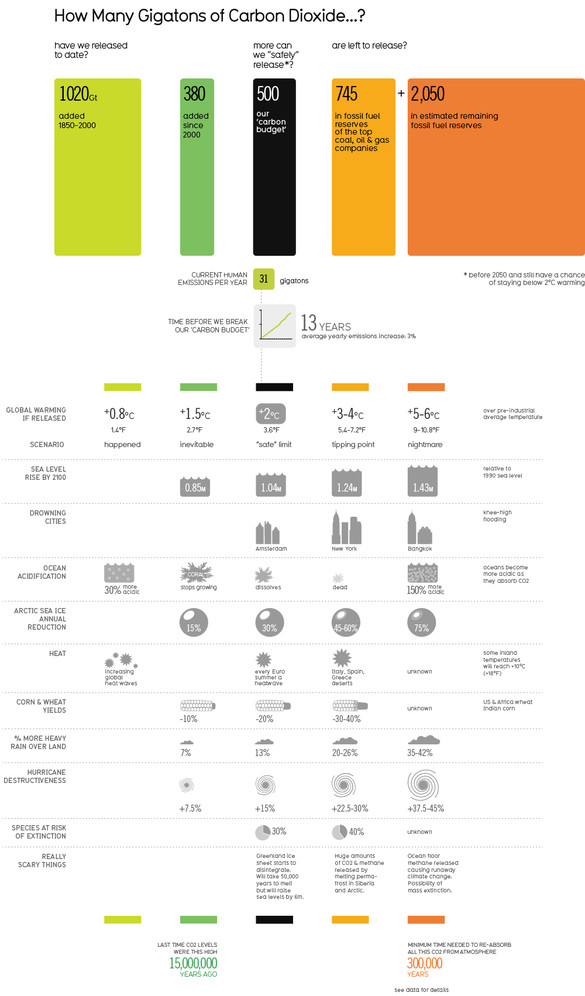
Our left carbon budget

We’re now in the black-bar phase, eating up our available «carbon budget» before we hit dangerous levels of temperature rise.

If we go beyond the ‘safe limits’ we won’t be able to reverse the sea level rise, ocean acidification, sea ice reduction, agricultural yields, hurricane destructiveness, … the destruction of our own habitat.

Startup Engineering course by Standford

Again something from Coursera, a free 10 weeks course to learn some basic programming skills on how to build an Internet-mobile startup (by Standford University)
Course Syllabus
The syllabus is optimized to enable students to iterate on their final projects as soon as possible, with technical material in the first half of the class and entrepreneurial considerations in the second half.
  • Introduction and Quickstart
  • Tools: VMs, IAAS/PAAS, Unix Command Line, Text Editors, DCVS
  • Frontend: HTML/CSS/JS, Wireframing, Market Research
  • Backend: SSJS, Databases, Frameworks, Data Pipelines
  • APIs: Client-side templating, HTTP, SOA/REST/JSON, API as BizDev
  • Devops: Testing, Deployment, CI, Monitoring, Performance
  • Dev Scaling: DRY, Reading/Reviewing/Documenting Code, Parallelizing
  • Founding: Conception, Composition, Capitalization
  • Business Scaling: Promotion, CAC/LTV/Funnel, Regulation, Accounting
  • Summary and Demo Week

Tribute to Mark Twain

Excerpt from Mark Twain’s autobiography

«For many years I believed that I remembered helping my grandfather drink his whisky toddy when I was six weeks old but I do not tell about that anymore now; I am growing old and my memory is not as active as it used to be. When I was younger, I could remember anything, whether it had happened or not; but my faculties are decaying now and soon I shall be so I cannot remember any but the things that never happened. It is sad to go to pieces like this but we all have to do it.»

«Twenty years from now you will be more dissappointed by the things you didn’t do than the ones you did do. So throw off the bowlines. Sail away from the safe harbor. Catch the trade winds in your sails. Explore. Dream. Discover.»

Loos-en-Gohelle, pueblo minero reconvertido a pueblo sostenible

En la zona Norte de Francia, en la región del Paso de Calais el pueblo de Loos-en-Gohelle se vio obligado a reinventarse. En el año 1990 la actividad minera de la región se desmantela y da paso a una etapa de transición hacia un nuevo modelo. En un inicio se apostó por la creación de empresas auxiliares a la industria automovilista, empresas que se vieron afectadas por la continua deslocalización, lo que llevó a la comunidad de Loos-en-Gohelle a atacar el problema desde la base, a cambiar la actitud y la forma de pensar.
Hoy Loos-en-Gohelle es una comunidad que sigue el camino de la sostenibilidad siguiendo cuatro premisas fundamentales:
  1. Cambio de mentalidad
  2. Desarrollo sostenible a partir de iniciativas locales
  3. Generalizar el desarrollo sostenible a todo el territorio, cambiando toda la ciudad.
  4. Evaluación contínua, investigación, especialización, ventajas de escala y clusters
Algunas iniciativas puestas en marcha en Loos-en-Gohelle:
COMPRA VERDE: El ayuntamiento lo compra todo reciclado, figura como condición en los pliegos. Además se prima la compra local y la baja huella ecológica (menor transporte, menor consumo de recursos no renovables…)
AHORRO EN AGUA Y SANEAMIENTO: el ayuntamiento no gasta ni un céntimo en agua, toda la que utiliza es de lluvia almacenada o reciclada. Hay estanques por la ciudad como elementos ecológicos y ademas como reservorios de agua. Se han desimpermeabilizado las superficies poniendo aparcamiento verdes donde el agua de lluvia se infiltra al terreno en lugar de acabar en un colector y en una depuradora sobredimensionada y con enormes tanques para las tormentas. En Loos solo va a depuradora el agua residual, la de lluvia se infiltra allí donde cae al terreno o se aprovecha para riego y servicios varios.
MOVILIDAD SOSTENIBLE: aquí falta mucho por hacer en transporte público, pero al 50% de los colegios se llega caminando, se han creado caminos peatonales para ello y se han distribuido de modo que sea más equitativo y más cercano el acceso a los centros públicos.
JARDINES Y HUERTOS ESCOLARES: se han creado en todos los centros cuyas AMPAS han querido colaborar, van los abuelos a enseñar a los niños a cuidar y cultivar, de este modo además se interrrelacionan.
ORDENACIÓN TERRITORIAL: se trabaja para juntar de nuevo los tres espacios vitales: donde duermes, donde trabajas y donde realizas tu ocio, dando con ello vida a la ciudad y ahorrando en transporte. Las ciudades del pensamiento único separan estos tres espacios dejando los barrios sin vida. Antiguamente no era así. Trabajo, ocio y reisdencia en un mismo lugar es más saludable, más social y más ecológico, las personas prierden menos tiempo en viajes, se gasta menos, se contmaina menos y las ciudades y barrios tienen vida social.
ECOCONSTRUCCIÓN: en Loos se han especializado en ecoconstrucción con materiales reciclados y técnicas y diseños de eficiencia climática. Hay varias promociones de viviendas públicas con esos criterios, que consiguen reducir el gasto en calefacción en un 90% (de 1500 euros/año a 150 euros/año, este dato es real, con facturas en la mano, y es para toda la vida de la vivienda). Las empresas privadas vienen ahora a Loos a aprender y a formar a sus técnicos.
POLO DE COMPETITIVIDAD PARA RECICLADO DE MATERIALES, con 12 millones de euros al año para investigación y desarrollo. Han creado un centro de investigación para desarrollar nuevos materiales reciclados y nuevos procesos de reciclaje. Ahora las empresas privadas van a Loos a formar a su personal en estas técnicas y construyen con ellas. Todos los datos de estos centros públicos están disponibles en red en los centros de ingeniería de Francia, todos los resultados se publican.
ESCUELA DE ECOCONSTRUCCIÓN: tienen un centro de formación profesional de ecoconstrucción.
MERCADO DE MATERIALES RECICLADOS, con exposición de técnicas de empleo. Investigación: Se analiza el ciclo de vida de los materiales, desde su producción, los elementos que se emplean, hasta su uso tras ser desechados.
PLATAFORMA DE ENERGÍA SOLAR: con menos horas de sol que Asturias son líderes en energía solar, son una referencia. Han hecho una central solar por medio de participaciones, cada personas que quería compraba un panel del conjunto. Los han vendido todos en horas y tiene una central solar colectiva que abastece a varios cientos de viviendas. Además han creado un centro de energías alternativas que prueba todos los sistemas existentes para saber si los fabricantes dicen la verdad y para evaluar a que tipo de entorno son más apropiados.
DEPORTE Y TIEMPO LIBRE: es muy importante para el desarrollo personal, se hacen muchísimas actividades, incluida una maratón por las escombreras.
ARTE también pretenden ser el Louvre en la antigua cuenca minera, con un convenio con el Louvre. Han hecho land-art con las escombreras
PAISAJE es fundamental para el bienestar de las personas y la actividad económica. Reforestación, cinturón ecológico, paisajes culturales, peatonalización, praderas accesibles…incluido el Patrimonio Minero, como paisaje cultural. Si no hay paisaje y entorno sanos y agradables, no habrá desarrollo económico en el futuro. Ellos en Loos no tenían paisaje ni naturaleza; ve que asturias si tiene, lo cual es una ventaja para nosotr@s.

Sustainable Energy for all

This weekend someone asked me about how feasible would be to supply all the energy demand with renewable energy. My answer was not very optimistic. In Spain, nowadays, only 15% of the energy comes from renewable sources and as far as I know the main research efforts are driven by the need of finding a substitute to oil, an energy that can be easily stored, transported and used under demand by the existint transportation fleet.
That does not cover the need of generating green energy for all the planet population. Lack of access to energy goes hand in hand with poverty. Research should focus on cheap energy generation from an ilimited source, rather than trying fo find a substitute that can keep the growth path, started a century ago, with the use of oil.
1.2 billion people still lack access to electricity, and 2.8 billion don’t have access to modern household fuels. Renewable energy accounts for only 18 percent of the global energy mix.
Projects like the SE4ALL of the WorldBank try to make a change. Will they achieve to give energy to that 1.2 billion people that doesn’t have it now? 
Unfortunately, with the three goals they point out, in 17 years time, still a high percentage of the world population will lack access to energy.