Muy buen vídeo sobre cómo han convertido una huerta de frutales tradicional, al cultivo permacultural.
Europa, ¿tú qué quieres ser de mayor?
La cumbre de Varsovia toca su fin y de nuevo Europa parece que es el único bloque que sigue apostando y comprometiéndose con una reducción de emisiones de CO2, como motor básico para evitar el cambio climático.
Hoy no toca que opine sobre el mercado de emisiones (que sabéis no es santo de mi devoción), pero sí, sobre esa doble pose que mantiene la Unión Europea en todo lo tocante a temas medioambientales y que desde mi punto de vista, no nos está llevando a buen puerto.
‘Banki Moon pide a la UE que siga liderando la lucha contra el cambio climático‘. Es cierto que de los países industrializados los que más se preocupan son los europeos, ¿pero está Europa manteniendo una política de veras sostenible o está haciendo un lavado de cara en los supra organismos mundiales?
Si de verdad Europa quisiese erigirse en defensor del desarrollo sostenible, entendiendo el desarrollo sostenible como una conjunción de políticas sociales, culturales, económicas y empresariales, como una nueva forma de pensar y de hacer, como un modelo para conseguir una evolución armónica entre economía y ecología, como un nexo entre medio ambiente y desarrollo, entre el bienestar de las generaciones actuales y el de las venideras, entre el hombre y el resto de la biosfera, si Europa apostase por el desarrollo sostenible debería de una vez por todas eliminar de su lista de prioridades el promover y fortalecer el famoso Mercado Único.
La Tierra es un todo, que los países, los gobiernos y por ende las sociedades, hemos decidido partir en trocitos y hemos llegado a creernos nuestra mentira de que lo que se hace en un país no afecta al resto y si lo hace, tienen la libertad y el derecho de hacerlo porque son independientes y para eso el país es suyo. Es tan absurdo como pensar que pudiésemos delimitar con fronteras imaginarias partes de un cuerpo humano y actuar como si cada una fuese independiente del resto.
Y hecho ese pequeño punto y aparte sobre lo absurdo de las fronteras, vuelvo a …¿cuál es el futuro de Europa?, ¿hacia donde van los 28 países que la integramos? Parece que Europa dentro de los países industrializados se posiciona como el menos malo, como el referente en la lucha por el cambio climático, el promotor de la sostenibilidad, desde aquel informe Brutland del 87, pero ¿cuál ha sido y sigue siendo la ideología de base que marca la redacción de las directivas europeas? Yo creo que sigue siendo el mercado único.
Si la UE de verdad se posicionase como líder en la lucha de cambio climático y empezase a aplicar políticas sostenibles por encima de su máxima de mercado libre dentro de la Unión, podría convertirse en el líder del futuro, pero… bañarse y guardar la ropa no llevan sino a una escalada en el sector público y una pérdida de competitividad en el sector privado, llevan a improvisar un camino que nos lleva hacia un futuro incierto en el que quedaremos al albur de las políticas que fijen otros países.
Si yo tuviese que invertir en el futuro, lo haría en:
– Biodiversidad
– Sostenibilidad
– Energía descentralizada
– Agua
– En redes resilientes
Europa debería pensar dónde quiere invertir, porque donde invierta hoy, será de donde cojan los frutos las próximas generaciones y es que el camino de la sostenibilidad no premia a la improvisación, sino a la constancia, al esfuerzo y a la apuesta y compromiso por un cambio real.
Cumbre de cambio climático – Varsovia
El Lunes se inauguró la XIX Cumbre mundial sobre cambio climático organizada por Naciones Unidas. Los años pasan y releyendo el blog veo que ya hemos hablado de la de Copenhage (2009) y la de Durban (2011).
Los plazos firmados en Kyoto han vencido y deben establecerse nuevos compromisos, sabiendo que USA y China no están y el primer ministro de Australia ha declarado que a falta de compromiso de otros países desarrollados, no están dispuestos a mantener sus compromisos de reducción de emisiones para el 2020.
Si cuando la economía bullía fue difícil conseguir un compromiso global, hoy que hasta arañar pequeñas migajas del pastel es una tarea ardua, conseguir que esta cumbre obtenga compromisos firmes va a ser misión imposible.
Esperemos a los resultados y veamos en 2015, cuántos ratifican lo que acuerdan durante esta semana de cumbre.
Waste, waste, waste everywhere
In the last days it seems like everyone is talking about the waste problem. We have finally realized that we cannot keep the irrational pace of our consumption society waste generation.
Solid waste — the stuff we send down our chutes, discard at work and put on the curb every week — is a striking by-product of civilization. The average person in the United States throws away their body weight in rubbish every month. When waste management works well, we give it little thought: out of sight and, usually, quickly out of mind. Discarded materials are collected, some are recycled or composted, and most are landfilled or incinerated. But the global view is troubling.
The waste problem is acute in emerging cities. Landfills such as Laogang in Shanghai, China; Sudokwon in Seoul; the now-full Jardim Gramacho in Rio de Janeiro, Brazil; and Bordo Poniente in Mexico City vie for the title of the world’s largest. Each typically receives more than 10,000 tonnes of waste per day. Rapidly developing cities such as Shenzhen in China are adding to the world’s 2,000-plus inventory of waste incinerators. With the largest able to process more than 5,000 tonnes per day, concerns over ash disposal, air pollution and costs are rising too.In the past century, as the world’s population has grown and become more urban and affluent, waste production has risen tenfold. By 2025 it will double again1. Rubbish is being generated faster than other environmental pollutants, including greenhouse gases. Plastic clogs the world’s oceans and rivers, causing flooding in developing-world cities. Solid-waste management is one of the greatest costs to municipal budgets.
As city dwellers become richer, the amount of waste they produce reaches a limit. Wealthy societies tend to curb their waste. So as living standards around the world rise and urban populations stabilize, global solid-waste generation will peak.
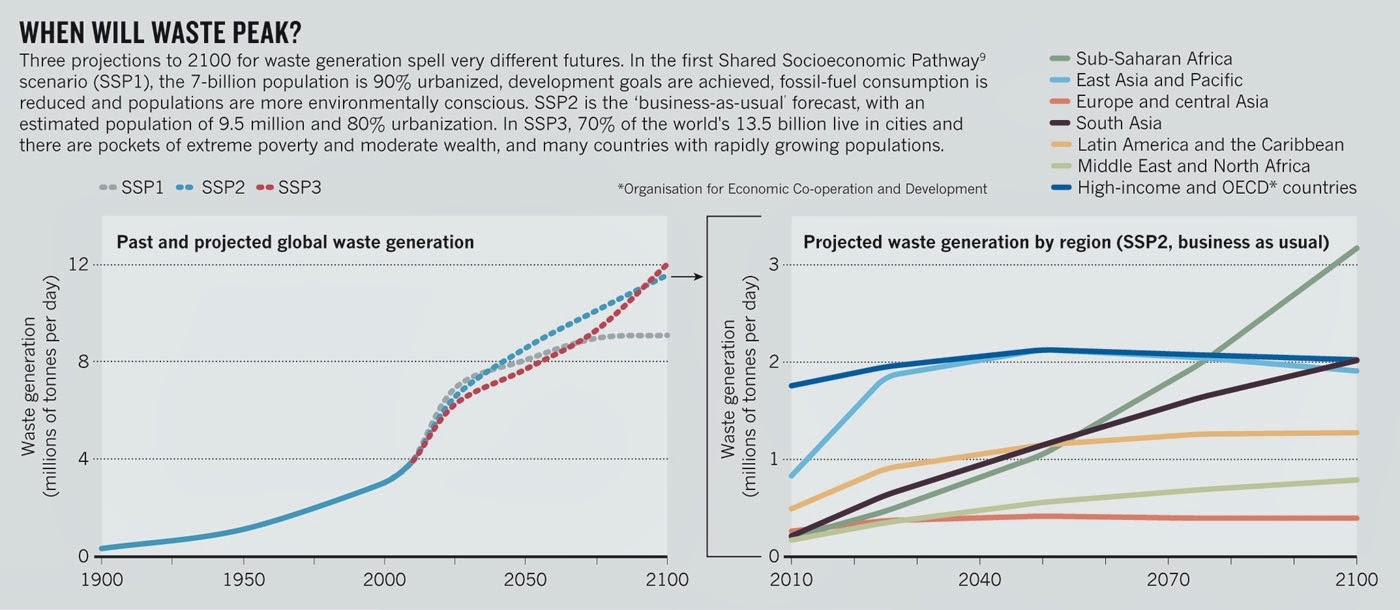
Just when is difficult to predict. But by extending current socio-economic trends to 2100, we project that ‘peak waste’ will not occur this century. Unless we reduce population growth and material consumption rates, the planet will have to bear an increasing waste burden.
Urban problem
Solid waste is mostly an urban phenomenon. In rural communities there are fewer packaged products, less food waste and less manufacturing. A city resident generates twice as much waste as their rural counterpart of the same affluence. If we account for the fact that urban citizens are usually richer, they generate four times as much.
Together, the member countries of the Organisation for Economic Co-operation and Development (OECD) are the largest waste generators, producing around 1.75 million tonnes per day. This volume is expected to increase until 2050, owing to urban population growth, and then to slowly decline, as advances in material science and technology make products smaller, lighter and more resource efficient.As urbanization increases, global solid-waste generation is accelerating. In 1900, the world had 220 million urban residents (13% of the population). They produced fewer than 300,000 tonnes of rubbish (such as broken household items, ash, food waste and packaging) per day. By 2000, the 2.9 billion people living in cities (49% of the world’s population) were creating more than 3 million tonnes of solid waste per day. By 2025 it will be twice that — enough to fill a line of rubbish trucks 5,000 kilometres long every day.
Some countries generate more waste than others. Japan issues about one-third less rubbish per person than the United States, despite having roughly the same gross domestic product (GDP) per capita. This is because of higher-density living, higher prices for a larger share of imports and cultural norms. Waste quantities worldwide can also vary seasonally, by up to 30%, as horticultural and food wastes fluctuate. For example, household waste volumes double in the week after Christmas in Canada.
Waste reduction and dematerialization efforts in OECD countries are countered by trends in east Asia, particularly in China. China’s solid-waste generation is expected to increase from 520,550 tonnes per day in 2005 to 1.4 million tonnes per day in 2025. East Asia is now the world’s fastest growing region for waste, a distinction that is likely to shift to south Asia (mainly India) in 2025, and then to sub-Saharan Africa around 2050.
As a country becomes richer, the composition of its waste changes. With more money comes more packaging, imports, electronic waste and broken toys and appliances. The wealth of a country can readily be measured, for example, by how many mobile phones it discards. Solid waste can thus be used as a proxy for the environmental impact of urbanization. Most of a material’s impact is through production and use. Less than 5% stems from waste management, which includes emissions from collection trucks, landfills and incinerators.
Peak waste
The rate at which solid-waste generation will rise depends on expected urban population and living standards growth and human responses. In 2012, two of us (D.H. and P.B.-T.) authored a World Bank report, What a Waste1, which estimated that global solid-waste generation would rise from more than 3.5 million tonnes per day in 2010 to more than 6 million tonnes per day in 2025. These values are relatively robust, because urban populations and per capita GDP can be well forecast for several decades.
Using ‘business-as-usual’ projections, we predict that, by 2100, solid-waste generation rates will exceed 11 million tonnes per day — more than three times today’s rate. With lower populations, denser, more resource-efficient cities and less consumption (along with higher affluence), the peak could come forward to 2075 and reduce in intensity by more than 25%. This would save around 2.6 million tonnes per day.Extending those projections to 2100 for a range of published population and GDP scenarios shows that global ‘peak waste’ will not happen this century if current trends continue (see ‘When will waste peak?’). Although OECD countries will peak by 2050 and Asia–Pacific countries by 2075, waste will continue to rise in the fast-growing cities of sub-Saharan Africa. The urbanization trajectory of Africa will be the main determinant of the date and intensity of global peak waste2.
Convert and divert
How can today’s situation be improved? Much can be done locally to reduce waste. Some countries and cities are leading the way. San Francisco in California has a goal of ‘zero waste’ (100% waste diversion by reduction and recycling) by 2020; already more than 55% of its waste is recycled or reused. The Japanese city of Kawasaki has improved its industrial processes to divert 565,000 tonnes of potential waste per year — more than all the municipal waste the city now handles. The exchange and reuse of materials connects steel, cement, chemical and paper firms into an industrial ecosystem3.
But greater attention to consumption and improvement in waste management is needed in rapidly urbanizing regions in developing countries, especially in Africa. Through increased education, equality and targeted economic development, as in the sustainability scenario we evaluated6(SSP1), the global population could stabilize below 8 billion by 2075, and urban populations shortly thereafter. Such a path reflects a move towards a society with greater urban density and less overall material consumption7. Also needed is a widespread application of ‘industrial ecology’ — designing industrial and urban systems to conserve materials. This begins with studies8 of the urban metabolism — material and energy flows in cities.North America and Europe have tried disposal fees, and found that as fees increase, waste generation decreases. Another tactic is to steer people to buy less with their increased wealth, and to spend more on experiential activities that require fewer resources4, 5.
Reducing food and horticultural waste is important — these waste components are expected to remain large. Construction and demolition also contribute a large fraction by mass to the waste stream; therefore, building strategies that maximize the use of existing materials in new construction would yield significant results.
The planet is already straining from the impacts of today’s waste, and we are on a path to more than triple quantities. Through a move towards stable or declining populations, denser and better-managed cities consuming fewer resources, and greater equity and use of technology, we can bring peak waste forward and down. The environmental, economic and social benefits would be enormous.
- Nature
- 502,
- 615–617
- ()
- doi:10.1038/502615a
Energía y compostaje
Parece que en el futuro el compostaje va a cobrar protagonismo. Cada vez compostaremos más porque el residuo orgánico es uno de los grandes problemas de los residuos, por peso, volumen y por su frecuente final en vertedero con las consiguientes emisiones de metano.
Si vamos a compostar pensemos que además de hacer compost podemos generar energía.
La generación no sólo puede producirse por biometanización, también se pueden montar sistemas en casa que nos permitan calentar el agua, el sistema de Jean Pain es uno de ellos, sobre el que hay múltiples evoluciones y vídeos de DIY en internet.
Does Coal Have a Long-Term Future in Europe?
European coal consumption had been in decline for several decades, as shown in Figure 1. However, coal has recently made a surprising comeback, regaining market share since 2010 mainly at the expense of natural gas. As the figure also shows, the opposite has happened in the U.S. where the relationship between coal and gas consumption was rather stable until about 2005, but the shale gas revolution has since led to a sharp decline in the consumption of coal relative to gas.
A first point is thus that the “comeback” of coal in Europe constitutes the mirror image of the strong decline in the U.S.
Even more importantly, the short-term reversal of the European trend in favor of coal needs to be viewed in the context of the uncertain long-term future stemming from coal’s significant carbon footprint.
In power generation, responsible for three-quarters of EU coal consumption, the main competing generation sources are either about half as CO2-intensive (natural gas) or essentially CO2 free (nuclear and renewables). As the EU is committed to reducing CO2 emissions by 80–95% through 2050 (compared to 1990 levels), coal-fired power generation units would largely need to be phased out unless coal can be decarbonized.
Carbon capture and storage (CCS) is the only feasible way to largely eliminate CO2 emissions from coal. But it is still far from clear whether CCS will turn out to be a commercially viable option: Aside from financial viability, a number of challenges must be overcome, including transport and storage issues as well as public opposition to CCS. What is clear, however, is that some sort of CO2 price is essential to trigger investments in CCS.
From this perspective, recent developments are alarming. The EU Emissions Trading Scheme (ETS)—the EU’s flagship policy instrument to reduce the EU’s greenhouse gas emissions cost-effectively—has proven unable to provide a sufficiently high, stable, and predictable price signal to attract market-based investments in low-carbon technologies such as CCS. In addition, a structural reform that would reinvigorate the EU ETS seems highly unlikely in Europe’s current political climate.
Explicit vs. Implicit CO2 Prices
The oversupply of allowances that led to the collapse of the EU ETS is due partially to the economic crisis, which has reduced power demand below expectations. Another important reason is that European policy makers were—and still are—not willing to rely solely on the ETS to steer the transition to a low-carbon economy in Europe. Instead, they have adopted additional measures, most notably increased support for renewables and energy efficiency. Whereas these complementary measures also aim to drive decarbonization, they are interacting in sometimes undesired ways, undermining the visible price signal provided by the EU ETS.
Thus, instead of having a single and explicit price for CO2 all across the EU, there are now a number of different implicit CO2 prices. For example, as stipulated by the EU Directive on the promotion of the use of energy from renewable sources, individual EU member states have implemented national support schemes for renewables. Each national support scheme effectively leads to a different implicit CO2 price, varying by member state and renewable technology,
The order of magnitude and the range between the estimates is striking. Even for wind, generally the most competitive renewable, the implicit CO2 price was more than 10 times higher than the explicit CO2 price provided by the EU’s current ETS (which is about €4/tonne). Solar was more than 100 times as expensive, in terms of CO2 emissions avoided, than the current ETS price.
This result—that the implicit CO2 price of renewable incentives exceeds by far the explicit price via the ETS—was true even when the ETS price was somewhat higher than today’s €4/tonne. Even at the prices of some €20/tonne, as has been observed in the past, the renewable support implied a much higher carbon price.
The EU is not the only part of the world which sees such a large disparity between implicit and explicit CO2 prices. In California’s Emissions Trading Scheme, the majority of emissions reductions are achieved by complementary policies. Other U.S. states do not have an explicit CO2 price at all, but rely entirely on standards and other traditional forms of regulation. As any visible carbon price seems to be politically unacceptable in the U.S., one would expect the imbalance toward implicit CO2 prices to increase in the future. And, indeed, as voiced by a leading exponent of the U.S. coal industry in the inaugural issue of Cornerstone, it is expected “that a standard for CO2 emissions will come”.
Does this imbalance between explicit and implicit CO2 prices play out in favor of coal or does it put the future of coal in Europe’s energy mix at risk? This comes down to the question of how coal is affected by the various carbon prices, in comparison to its main competitors in power generation. In the EU, coal, which accounts for about one-quarter of electricity generation, mainly competes with natural gas, which has a similar, but somewhat smaller share in power generation, as well as nuclear and renewables.
Coal vs. Gas
On the face of it, the present state of EU climate policies works out well for coal. Since mid-2011, coal-fired power plants are generally more competitive than natural gas-fired plants and could thereby regain market share. This spread has further increased in early 2013.4 The trend is also evident in the consumption patterns of coal and gas depicted in Figure 1. While EU gas consumption declined by 2.3% from 2011 to 2012, coal consumption increased by 3.4%.1
The significant gain in competitiveness of coal is due to two main reasons. First, coal benefits from the relatively low CO2 price. Second, coal import prices have fallen as U.S. coal producers have had to look for other markets, since natural gas has reduced the role of coal in the U.S. energy mix as a side effect of the U.S. shale gas revolution.
The CO2 price at which production costs for coal- and gas-fired power plants would be equal depends on the efficiency of the power plants and the relative prices of both coal and natural gas. At the commodity price levels of early 2013, a very efficient gas-fired power plant (58% efficiency) would already have been competitive with an old inefficient coal plant (28% efficiency) at an ETS price of €10/tonne CO2, as shown in Table 2. A modern and efficient coal plant (42%), by contrast, would outcompete rather inefficient gas-fired generation capacity (41%) up to a CO2 price of €85/tonne. If both coal- and gas-fired power plants are rather efficient (42% and 58%, respectively), a CO2 price of €38 would be the point at which coal and gas production costs are equal.
Notes: Prices as of early 2013: gas, €26/MWh; coal, €10.5/MWh (including €1/MWh transport costs to plants). Numbers in parentheses refer to assumed plant efficiency and CO2 emissions per MWh electricity.
Currently, coal is generally the most competitive fossil-fuel-fired source of power generation in Europe. To what extent this remains so in the future depends on both CO2 and commodity price developments.
The relative price of coal (to natural gas) has decreased in Europe, while the U.S. has seen the opposite trend.
The Northwest Europe marker price and the Average German import price are used as proxy for EU coal and natural gas prices, respectively. For the U.S., the Central Appalachian coal spot price index and Henry Hub natural gas prices are taken.
The level of CO2 prices hinges upon political choices made by policy makers. Here, the lack of a higher explicit CO2 price benefits coal in the short term. However, it is doubtful whether the present situation allows for a future for coal in the EU’s electricity mix. Without a higher CO2 price, companies have little incentive to invest in CCS or alternative technologies. And unless coal will be decarbonized, it will have to be phased out at some point if the EU is to meet its decarbonization objectives. Without an explicit and technology-neutral CO2 price, it seems likely that coal will eventually silently be phased out through targeted government actions such as standards or a coal tax. An explicit CO2 price would also have the advantage of providing auctioning revenues which could be used to fund CCS projects, further supporting the decarbonization of coal.
Auctioning revenues have been very limited so far, as most allowances have been allocated for free and the carbon price is presently very low. But these revenues could increase significantly in the future as the share of auctioning increases every year (free allocation will be completely phased out by 2027). EU member states enjoy considerable discretion when it comes to spending the auctioning revenues, but the EU ETS Directive requires that at least half of the revenues be used for measures to mitigate climate change. Member states could thus, for instance, invest this money in CCS demonstration projects. Additional funding is available through the NER300 programme managed by the European Commission, also financed through auctioning revenues.
A substantial price on CO2—say, initially in the range of €20-30/ tonne—could thus be the key to preserve the future of coal in Europe. It would provide the auctioning revenues necessary to support and develop CCS while not making coal uncompetitive against gas in power generation. In the longer term, coal with CCS could then become a low-carbon alternative and compete with renewables and nuclear in a world where decarbonization is driven by increasing explicit and visible prices on CO2
By Daniel Gros Director, Centre for European Policy Studies &
Jonas Teusch Researcher, Centre for European Policy Studies
Plástico: especie invasora del s. XXI
Os dejo algunos documentales que intentan concienciar del enorme problema que tenemos con el plástico. Dependiendo de su composición, los plásticos tardan en desintegrarse entre 100 y 1.000 años.
¡Qué ese no sea tu legado a las próximas generaciones!
+ Trashed film
+ Waste not
+ Plastic Shores
+ Bag it
+ Midway
¿Bosque o desierto?
El bosque es vida ¿cuál es el precio de la biodiversidad?, ¿de la lluvia?, ¿del aire limpio?, ¿de un ecosistema sostenible? Hasta que la sociedad y la economía no den un valor tangible a todo esto, seguiremos expoliando y destruyendo nuestro hábitat y nuestro entorno, porque destruir genera beneficios y conservar tan sólo se considera un coste.
Fuimos hace 2000 años un bosque infinito, vamos camino de ser un desierto…
El agua, un bien escaso, cuídala
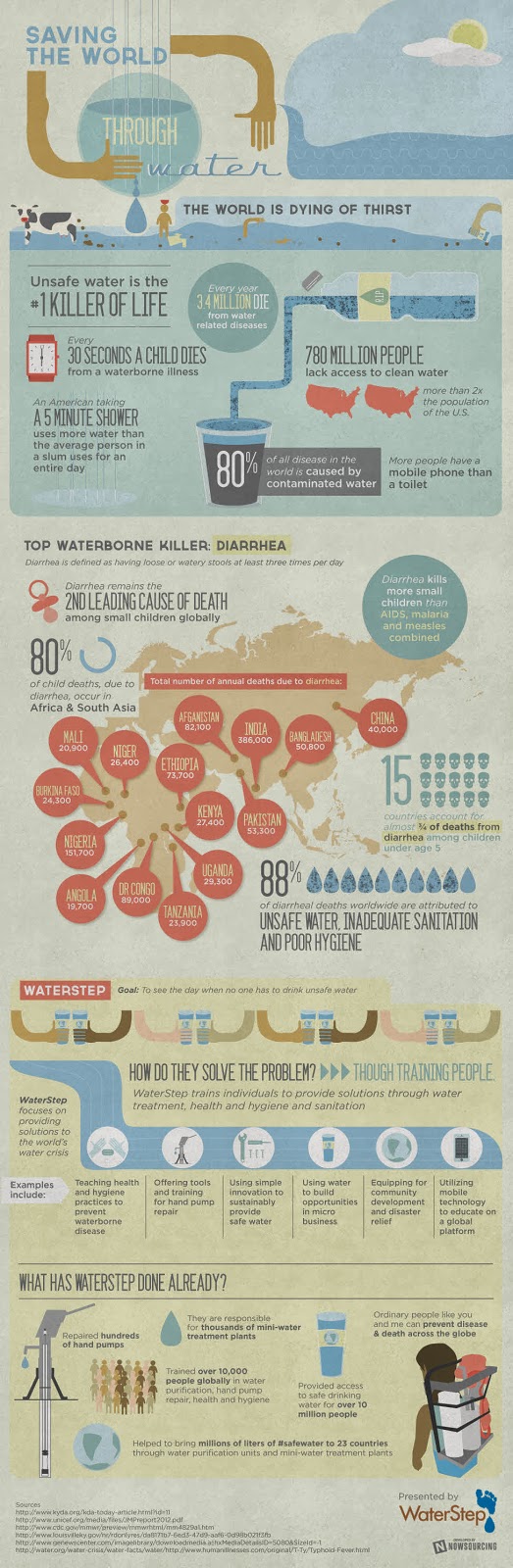
- 875 milliones de personas viven sin agua potable en el mundo y 2.500 millones de personas viven sin inodoros.
- Un niño muere cada 30 segundos debido a la ingesta de agua en mal estado o por falta de higiene.
- 80% de las enfermedades en el mundo se deben al consumo de agua contaminada o falta de sanidad.
- Cada día, millones de mujeres y las niñas dedican más de 200 millones de horas yendo a por agua a pozos o fuentes de agua que muchas veces están contaminados.
- 88% de las muertes por diarrea se deben a la falta de instalaciones sanitarias o falta de agua. Algo tan simple como poder lavarse las manos con jabón podría reducir a la mitad las muertes por diarrea en el mundo.
- 1,76 milliones de muertes podrían evitarse cada año si toda la población tuviese acceso a agua potable, sanitarios e higiene.
+ info
http://www.unicef.org/wash/index_statistics.html
http://www.unwater.org/statistics_san.html
http://www.gwp.org/en/
http://who.int/topics/water/en/
El club de Roma se reúne… De nuevo
Acaba de terminar la reunión anual del Club de Roma, este año en Ottawa. El tema candente vuelve a ser el cambio climático y de nuevo cuarenta años después de que se publicase el famoso informe de los límites del crecimiento en 1972, revisado ya en varias ocasiones, se vuelve a deshojar la misma margarita:
– Tomar medidas drásticas que permitan frenar la destrucción de nuestro planeta
– Intentar que la industria no sufra y tomar medidas blandas que limpien conciencias
… como quien flirtea con un novio al que no queda muy claro si se le quiere o no, así nosotros sin tomar una posición clara a nivel mundial, continuamos nuestra carrera de expolio y crecimiento irracional, mientras vamos acabando con los recursos de nuestro propio hábitat, gestando una debacle medioambiental sin precedentes.
+ info (bankrupting nature & plundering the planet)