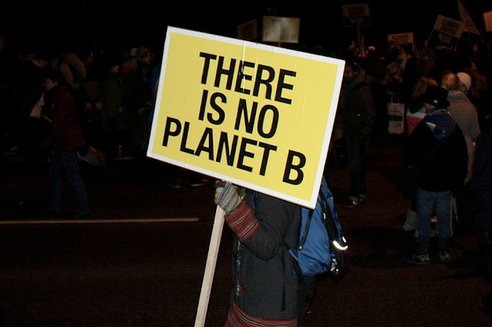
No hay un planeta B

Después del fiasco de Copenhage parece que la cumbre de Durban seguirá sus pasos y volverá a ser un fracaso. USA no se moja, Canadá tampoco, Europa inmersa en su actual debacle de si continua con una sola moneda o se fracciona y arrastra al mundo occidental al pozo económico, ni siquiera ha intentado aportar valor a la cumbre. En cuanto a Asia, está demasiado ocupada en no dejar de crecer como para plantear políticas de conservación y estancamiento.
El mundo se debate en las contradicciones de un modelo económico que muere, por que es insostenible, y la inercia de una sociedad occidental que se ha acostumbrado a la comodidad, facilidad y sobredemanda en todos y cada uno de los aspectos de su vida. Somos demasiados y pedimos demasiado a un mundo al que no le damos ni un respiro para poder renovar sus recursos, nuestros recursos. Más allá de la crisis de euro o del dólar, la verdadera crisis es la del agua, la de los alimentos, la de la biodiversidad, la de la deforestación, la acidificación de nuestros mares. Estamos esquilmando el mundo y destrozando nuestro propio hábitat.
Inmersos en la codicia y la comodidad y creyendo a pies juntillas las falsas promesas que los Gobiernos hacen de que, con sacrificio nuestro y del planeta, se podrá volver a crecer y mantener este sistema absurdo en el que vivimos, no nos damos cuenta de que más allá del corto plazo, marcado por la crisis financiera y de crédito, el verdadero problema está en nuestro modelo de vida. No podemos seguir consumiendo más recursos de los que el planeta genera. Es tan simple que hasta un niño pequeño lo entendería.No nos engañemos. Nadie va a diseñar un plan B, no hay un planeta B y estamos acabando con el único que tenemos, con el que nos da de comer y nos ofrece las condiciones óptimas para una especie, la humana, frágil y débil.

La solución no va a venir de conferencias, cumbres, gobiernos o cualquier tipo de organización supranacioal. La solución debe comenzar en cada uno de nosotros y nuestro entorno. En nuestra comunidad, en nuestra forma de vida. Piensa que harías si no tuvieses agua corriente, si una sequía te dejase sin alimentos, si Europa cae en un invierno permanente porque se desestablece la corriente del Golfo…

¡Monta tu plan B! 

Entre todos podemos crear un plan B y dejar de confiar en un planeta B, que por ahora queda en el terreno de la ciencia ficción, donde debería quedar el modelo de crecimiento ilimitado.

The terrible consequences of a eurozone collapse

What happens if the euro collapses? A euro area breakup, even a partial one involving the exit of one or more fiscally and competitively weak countries, would be chaotic. A full or comprehensive break-up, with the euro area splintering into a Greater Deutschmark zone and about 10 national currencies would create pandemonium. It would not be a planned, orderly, gradual unwinding of existing political, economic and legal commitments. Exit, partial or full, would likely be precipitated by disorderly sovereign defaults in the fiscally and competitively weak member states, whose currencies would weaken dramatically and whose banks would fail. If Spain and Italy were to exit, there would be a collapse of systemically important financial institutions throughout the European Union and North America and years of global depression.
Consider the exit of a fiscally and competitively weak country, such as Greece – an event to which I assign a probability of about 20-25 per cent. Most contracts, including bank deposits, sovereign debt, pensions and wages would be redenominated in new Drachma and a sharp devaluation, say 65 per cent, of the new currency would follow. As soon as an exit was anticipated, depositors would flee Greek banks and all new lending governed by Greek law would effectively cease. Even before the exit, the sovereign and the banking system would fail because of a lack of funding. Following the exit, contracts and financial instruments written under foreign law would likely remain euro-denominated. Balance sheets would become unbalanced and widespread default, insolvency and bankruptcy would result. Greek output would collapse.
Greece would temporarily gain a competitive advantage from the sharp decline in the new Drachma’s value, but like Portugal, Spain and Italy, Greece does not have the persistent nominal rigidities to make it a lasting competitive advantage. Soaring wage and price inflation would restore the uncompetitive status quo. Without external funding, imports would collapse, disrupting domestic production. Aggregate demand and aggregate supply would chase each other downwards.
If Greece storms out of the eurozone there might be little fear other countries would follow suit.
However, if Greece is pushed out of the eurozone because other member states refuse to fund the Greek sovereign and the European Central Bank refuses to fund Greek banks, the markets could beam in on the next most likely country to go. This could prompt a run on that country’s banks and stop funding for its sovereign, financial institutions and companies. Fear might actually then force the departure of the afflicted country. Exit contagion might sweep right through the rest of the eurozone periphery – Portugal, Ireland, Spain and Italy – and then begin to infect the “soft core”of Belgium, Austria and France.
A disorderly sovereign default and eurozone exit by Greece alone would be manageable. Greece accounts for only 2.2 per cent of eurozone area GDP and 4 per cent of public debt. However, a disorderly sovereign default and eurozone exit by Italy would bring down much of the European banking sector. Disorderly sovereign defaults and eurozone exits by all five periphery states – an event to which I attach a probability of no more than 5 per cent – would drag down not just the European banking system but also the north Atlantic financial system and the internationally exposed parts of the rest of the global banking system. The resulting financial crisis would trigger a global depression that would last for years, with GDP likely falling by more than 10 per cent and unemployment in the West reaching 20 per cent or more. Emerging markets would be dragged down too.
Exits by Germany and other fiscally and competitively strong countries could be even more disruptive. This might occur amid attempts to introduce a one-sided fiscal union with open-ended and uncapped euro-bonds or other transfers from the strong to the weak without a corresponding surrender of fiscal sovereignty to prevent future crises or if the ECB were to “go Weimar”. I consider this highly unlikely, with a probability of less than 3 per cent. Following such an exit, Germany and the other core eurozone member states (perhaps excluding France) would introduce a new Deutschmark. The sovereigns in the periphery would default. The new Deutschmark would appreciate sharply. Financial institutions in the new area would have to be bailed out because of losses from exposure to the old periphery and the soft core. As nothing would be holding the remaining eurozone countries together, the rump would split into perhaps 11 national currencies. The legal meaning and validity of all euro-denominated contracts and instruments would be up for grabs. Everyone, except lawyers specialising in the Lex Monetae, would become much poorer.
Even if a break-up of the eurozone does not destroy the EU completely and precipitate the kind of conflicts that disfigured the continent in the past, the case for keeping the show on the road seems rather robust.
The writer is chief economist at Citi.
+ publicación original (Financial Times)

Future cities – ciudades libertarias

Seasteading, Blueseed, Charter Cities, Future cities = Ciudades libertarias

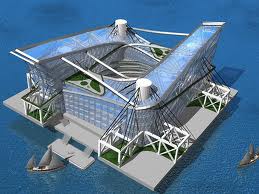
Parece que algo se mueve en el mundo de la creación de las ciudades libertarias. Hace poco salió a la luz Blueseed, la incubadora flotante de Silicon Valley apoyada por Peter Thiel, mientras que la fundación de seasteading (la del mismo Peter Thiel (co-fundador de Facebook)) recibía 1 Millión de dóllares de uno de los fundadores de Pay-Pal, poco antes o poco después de que el CEO de seasteading, Patri Friedman, abandonase los barcos flotantes para aparecer al frente de una nueva empresa Future Cities, con la misma filosofía que seasteading, pero radicando sus nuevas ciudades en tierra firme, en lugar de en estructuras flotantes.

Desde su nueva plataforma Friedman vuelve a coger ideas de Paul Romer y sus Charter cities  y prepara su primer prototipo en Honduras, todo ello envuelto en rumores de si Friedman fue invitado a abandonar o abandonó por sí mismo y mas críticas, de si las charter cities son un nuevo modelo de colonialismo o una forma de evitar el pago de impuestos.
Parece que la creación de ciudades-estado, al margen de los actuales y decadentes Gobiernos, no está gustando, al menos eso se diría de la cantidad de críticas que reciben el creciente número de proyectos que buscan la creación de nuevas formas organizativas, fuera de la podredumbre que nos rodea.

Consumo colaborativo

No podemos seguir consumiendo y comprando de forma ilimitada. Muchas veces compramos productos que usamos como mucho una sola vez, tras la cual quedan almacenados en algún rincón de nuestra casa, acumulando polvo y desperdiciando la energía y recursos que se necesitaron para fabricarlo ¿No sería mejor compartirlo, intercambiarlo, prestarlo y poder pedir prestados otros productos de esos que no usaremos más allá de una vez? A esto es a lo que le llaman ‘collaborative consumption‘ o de forma más castiza se le podría aplicar la expresión de ¡qué rule..!
Muchas de las webs que os incluyo te dan la opción de que tú des de alta tu barrio y pongas en marcha el servicio.Webs de préstamos entre vecinos:

Intercambio de ropa:
De coches:
De tierra cultivable
De regalos:
De intercambio de todo tipo:

Cigala. Garganta de arena

La fotógrafa alemana Anya Bartels-Suermondt ha publicado un monográfico de El Cigala, del mismo estilo del que publicó hace unos años de José Tomás (Serenata al amanecer).
Sabéis que para mí, El Gigala es más que un icono. Como decía Paco de Lucía ‘tiene una voz de caramelo que derrama el corazón en lo que canta’.
Son cuatro kilos de fotos, casi todas en blanco y negro. No sé si las restricciones de nuestro equipaje navideño nos permitirá traerlo…, se hará lo que se pueda.

The black cloud

Una recomendación de un británico de la zona. Es un libro antiguo, 1957. Curioso ver como hace sólo 54 años, los libros de ciencia ficción jugaban a imaginar adelantos que hoy, ya completamente desarrollados, están integrados en nuestra vida diaria.
Es un libro muy científico. La sensación después de la lectura es que se centra en explicar los hechos científicos y el funcionamiento de determinadas tecnologías, más que en el argumento.
Como en todas las discusiones con científicos, no falta la discusión sobre la existencia o no de Dios que cobra una importancia relativa en la última parte del libro.
Autor: Fred Hoyle
Nº pags: 240

Historical context of the Commons

«Earth, water, air and fire (what we would call, in contemporary terms, energy) have, for thousands of years, been considered primary elements and the common base materials of life, ever since the dawn of Western philosophical thought in ancient Greece. In the Metamorphosis by Ovid – a classic of Latin literature written more than two thousand years ago – the goddess Latona thus addresses a group of peasants who refuse to allow her to drink from a pool: “Why do you refuse me water? The common use of water is the sacred right of all mankind. Nature allows to no one to claim as property the sunshine, the air, or the water. When I drew near, it was a public good I came to share. Yet I ask it of you a favour (…). A draught of water would be nectar to me; it would revive me, and I would own myself indebted to you for life itself». These words condense the elements that were to proper legal regulation more than five hundred years later, in the Justinian Code. Contrary to the res nullius – goods that belong to no one and that can therefore be appropriated by whoever takes them first – air, water and sunshine are natural commons, that belong to everyone and because of this cannot be appropriated privately and exclusively by any one person. These are not goods from which is legal to make profits. They are inalienable goods, which are not even at the Princeps -that is, the Roman Emperor’s- disposal. Goods that are essential for life, hence connected to the fundamental rights of every human being. Rather, to be precise, the natural commons are in fact common to every living being – plants and animals included – if we do not want to remain trapped in a strictly anthropocentric point of view.
Nevertheless, over the centuries, the number of commons that have been annihilated and privatised has slowly grown: at the time of Justinian no one could have predicted that one day modern capitalism would be born of “enclosing” these goods nor that there would be a successive push towards privatisation, not only of the land but also of seeds and biodiversity, and then water, air and even knowledge itself (for example, through intellectual property rights).
By Michael Bauwens

The commons are vital to a sustainable economy

Since the first limited liability companies – the Dutch and British East India Companies – were formed, we have seen the kidnapping and enslavement of 20–60 million African people and the rape, murder and exploitation of indigenous people around the world. Colonisation was primarily about mercantile empires, not political ones. It was all about forcing indigenous, communitarian people to accept private individual ownership of resources, which could then be alienated, either by being bought or stolen. (Tanczos in Wall 2005: xiv)
The commons overcomes many of the problems with traditional state socialism because it tends to be flexible and decentralised. It has an inbuilt ecological principle based on the concept of usufruct, that is, access to a resource is granted only if the resource is left in as good a form as it was when first found. By extending this concept of usufruct, we can provide the basis of an ecological economy. By providing access, the commons enables prosperity without growth; if we have access to the resources we need, we can reduce wasteful duplication.
Preserving and extending the commons for forests, seas and other ecological resources is particularly vital. In the world’s rainforests, indigenous people almost universally use communal ownership to prevent ecological destruction of the forests. However, the commons principle can be applied far more widely. In the form of free software and access to the World Wide Web, it has already transformed the knowledge economy and decommodified access to culture and information. This, of course, is still imperfect: people in poorer communities may lack access to the Internet, and free Internet resources are still used to generate sales revenue.
Yet it already has had an extraordinary impact and shows that alternatives to private ownership are possible. It has already redistributed income from media corporations to consumers. 
Derek Wall, ‘The rise of the Green left’

Axeda, el futuro de Internet

Lo que algunos llaman el Internet de las cosas es ya una realidad. Los sensores se multiplican en redes públicas y privadas para tomar datos de temperatura, carga, tráfico, iluminación, rendimiento de maquinaria, volúmenes de líquido en tanques y cualquier otra cosa que pensemos que puede ser medida y cuya lectura pueda aportar un valor añadido a la optimización en la gestión de los recursos que nos rodean.

Muchas compañías están desarrollando esos sensores, otras han apostado por gestionar la información que todos esos sensores del Internet de las cosas envían por segundo. El líder es Axeda, que gestiona 10.000 transacciones por segundo, más de lo que gestiona Twitter en sus picos, que rondan los 7.000 twits por segundo.
Quizás me equivoque, pero si tuviese que apostar por un ganador en la carrera de la interconexión de las cosas a Internet, apostaría por Axeda.