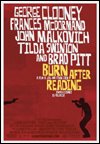
Noche de Halloween de cine, pero no una de miedo, sino una comedia que me encantó.
Aparte de que era un enredo que rallaba en la caricatura y de quiénes eran sus actores y directores, no sabía mucho más de la película.
La historia la resumiría en una frase del jefe de la CIA al final de la película: «Joder, un lío de cojones«. Después de un comienzo relativamente serio y formal en el que se van perfilando los personajes y el quién es quién en la trama, el argumento sufre un cambio radical a consecuencia de un hallazgo sin importancia, pero que a raíz de la obsesión y falta de buen juicio de los personajes, convierte su vida y la muerte de algunos, en un juego de enredo, divertido, pero que refleja esteoreotipos de vidas vacías, carentes de motivación y llenas de insatisfacción.
Para mí lo mejor de la película son sus personajes. El que más me gusto: Malkovich (reconozco que siento una clara predilección por él, que aumentó aun más después de ver la película de Being John Malkovich) que borda el histrionismo de su papel, después Clooney, con sus engaños obsesivos, y su frase de «tengo que irme a correr«, los dos papeles femeninos están muy a la par, Tilda Swinion (la de los pesticidas en Michael Clayton), que a base de verla hacer de mala, uno termina creyéndose que es un bicho, y Frances McDormand (la de Fargo), que a base de insistir, es la única que se sale con la suya en todo este embrollo. Por último Brad Pitt, que a pesar de que con este papel, dicen que se ha descubierto un nuevo gran cómico, a mi no me terminó de convencer.
Aparte de los personajes principales, me llamó muchísimo la atención el abogado de Katie, del que me fui pensando, que o era un abogado matrimonialista de verdad o un pedazo de actor.
Es una película divertida, fresca e irónica, que como dice la coletilla del título, demuestra que la inteligencia, como casi todo en esta vida, es relativa (en las personas y en las instituciones).
Este vídeo es de este verano. Está grabado en la isla del Aire, en las galerías de Cagaire y la verdad es que en este tipo de inmersiones se echa de menos la antorcha. Hay que hacer un auténtico ejercicio de flotabilidad para grabar, iluminar al punto de grabación con tu propio foco, y no dejar que la corriente te arrastre al fondo de la galería. Además con esa cara de pocos amigos que tienen las morenas, cuando las estás grabando y amagan a salir de su guarida, acojona un poquito, y eso que sé que si no se sienten amenazadas no atacan a un bicho mucho más grande que ellas.
Hace unos años, el fondo de la costa de Menorca estaba lleno de rayas como ésta. Incluso en las playas se podían ver muchas, simplemente con las gafas y el tubo. Ahora es un privilegio ver una en una inmersión, y ésta en cuanto nos vió de lejos, se marchó todo lo rápido que pudo. En aquella inmersión bajaba con un canario que la llamó chucho, pero me parece que el chucho canario es otra especie de raya diferente, más ancha y con la cola terminada de otra forma.
Al final esta vídeo me ha quedado muy corto. Bajo sin antorcha y el pulpo lo encontramos en una cueva. Al principio estaba grabando sólo con mi foco, y hasta que no llegaron refuerzos y me dieron un poco más de luz, el vídeo muestra sólo un pequeño círculo iluminado de las patas, cabeza y de cómo avanza el pulpo. En el tramo final (el que he subido), a pesar de que sigue oscuro, por lo menos, vemos al personaje casi al completo.
George Soros es un personaje controvertido, pero si algo se le reconoce, es su amplio conocimiento de los mercados financieros y su capacidad para adaptarse a los nuevos tiempos y ganar dinero con nuevas oportunidades de negocio.
El pasado Viernes, Bill Moyers le entrevistó, y aun a tenor de aburriros voy a poner los tres vídeos con la entrevista completa y para los que prefieran leerla, su transcripción íntegra.
La entrevista merece la pena para entender la crisis financiera en la que estamos inmersos y la crisis del modelo que ha reinado en los últimos 25 años. Los retos que tenemos por delante y una visión, la de Soros, de cómo deberíamos afrontarlos.
Transcripción
October 10, 2008
BILL MOYERS:Welcome to the Journal.
You are not alone if you are worried about the financial melt down. So is my guest George Soros, one of the world’s best known and successful investors, making billions in times of boom or bust. He’s been warning for years of a financial melt down fueled by easy credit and sleepy regulation. Now he’s out with this timely book, «The New Paradigm for Financial Markets: The Credit Crisis of 2008 and What It Means.»
In the interest of full disclosure, you should know that I served three years on the board of George Soros’ foundation, the Open Society Institute, dealing with such issues as a free press, the rule of law, and human rights. But I’ve had no involvement in his political activities and nothing to do, with his business interests unfortunately. It’s good to see you.
GEORGE SOROS:Same here.
BILL MOYERS:Let’s imagine for a moment that we’re not in a New York studio but we are in Neely’s Barbecue Stand in Marshall, Texas, my hometown, and we’re surrounded by people I know, people who have lost half of their 401(k)s in the last three or four weeks, and what they want to know is does this financial meltdown represent the end of the American dream as they have known it.
GEORGE SOROS:No. No. I think it’s got nothing to do with the American dream as such. There has been some kind of an ideological excess; namely, market fundamentalism for the last 25 or so years. And now that world is collapsing…
BILL MOYERS:What do you mean «market fundamentalism»?
GEORGE SOROS:It’s that markets will correct themselves, that you should leave it to the markets, and there is no need for government intervention in financial affairs. Letting markets run rampant. And that doesn’t work.
Markets have the ability to adjust and they’re very flexible. There is this invisible hand. But it is also prone to be mistaken. In other words, markets instead are reflecting reality. They always look at reality with a bias. There is always a prevailing bias. I’ll call it, you know, optimism/pessimism.
And sometimes those moods actually can reinforce themselves so that there are these initially self-reinforcing but eventually unsustainable and self-defeating boom/bust sequences or bubbles. And this is what has happened now.
This current economic disaster is self-generated. It was generated by the market itself, by getting too cocky, using leverage too much, too much credit. And it got excessive.
BILL MOYERS:You used the word «disaster.»
GEORGE SOROS:The financial system is teetering on the edge of disaster. Hopefully, it will not go over the brink because it very rarely does. It only did in the 1930s. Since then, whenever you had a financial crisis, you were able to resolve it. This is the most serious one since the 1930s, there hasn’t been one as serious as this.
Unfortunately, the authorities are behind the curve. They are reacting to these crises as they emerge. One thing leads to another, one market after another gets into difficulty. And they react to it. And they don’t quite understand what’s hitting them. So they are not anticipating and not gaining control of the situation.
BILL MOYERS:This is what’s interesting, why wouldn’t the government be able to look at what you looked at and see what’s coming?
GEORGE SOROS:Because actually they have been working on false premises. This sounds very strange, but there’s been this development of, this belief of market fundamentalism. And particularly the idea that markets always revert to the mean and deviations from the mean occur in a random fashion. And you can calculate it.
And you will get a nice distribution and you can anticipate it. And based on that, you can manage your risk. And that actually was based on a false idea. This namely, the markets self-correcting because the market moods have a way of affecting the fundamentals the markets are supposed to reflect.
And there’s always a divergence between our perception and what actually exists. For instance, take the simplest situation, namely housing.
Banks give you credit based on the value of the houses. But they don’t seem to somehow understand that the value of the houses can be affected by the amount of credit they are willing to give. Now, we’ve developed these fabulous new ways of securitizing mortgages, which has made credit much more amply available.
And we’ve been able to calculate risk. And, therefore, we were willing to give more and more credit. And that has pushed up the value of the houses. Also, of course Greenspan kept interest rates too low, too long. And so you had very low interest rates, easy credit, and house prices have been appreciating at more than ten percent a year for a number of years. And the willingness to lend actually increased. There was an insatiable appetite for these new fangled securities.
BILL MOYERS:Yeah. Nobody understood, really.
GEORGE SOROS:Which they didn’t properly understand. And there was always a separation between the people who generated the mortgages and packaged them and sold them to you and the people who owned them. So nobody was paying attention to the quality of the mortgages because they didn’t have an interest. They — all day collecting fees. And then there were other people holding the mortgages.
BILL MOYERS:Right.
GEORGE SOROS:And that was not factored into those instruments. The idea was that by distributing risk, you actually reduce risk. But by separating the principal from the agent, you actually greatly increase the risk. And that was not reflected. And the rating agencies didn’t realize it. So they gave triple-A ratings. And then a few weeks later, those triple-A bonds became practically valueless. And that’s what has happened.
BILL MOYERS:But how does the system become deranged like that? So separated from reality like an individual who goes insane because he or she is separated.
GEORGE SOROS:Well sometimes we get carried away. I mean, you know, let’s say in the Middle Ages, people were religious. And so they had tremendous discussions about how many angels can dance on the eye of a needle. Now, if you believe that angels can dance then that’s a legitimate question. And this is exactly what has happened here. You thought that you could slice and dice and engage in this kind of financial engineering. And it became very, very sophisticated and got carried away.
BILL MOYERS:What happened that we lost control?
GEORGE SOROS:There was a failure of regulations because they couldn’t understand these new instruments. But they said, «Oh, well, the banks have very good risk management techniques. So we leave it to them to calculate their own risks.»
And, you see, it wasn’t only in the housing market. There were all kinds of other financial instruments. So there was not just one bubble. I describe in my book there is the housing bubble. But this housing bubble, when that burst, it was only the detonator that exploded the bigger bubble, the super bubble.
Which is this 25 years of constant credit expansion using greater and greater leverage. The amount of credit in the economy has been growing at, I don’t know, I don’t know the exact figure, but maybe at least twice as fast as the economy itself. I think it’s more like three.
And now, suddenly, you have a contraction of credit. And it’s a sudden thing. And it’s a period of great wealth destruction. And that’s how these poor people in Texas suddenly find that their 401(k) is worthless.
BILL MOYERS:So as we talk, Secretary Paulson and the government seem to be coming around to what you’ve been advocating and that is taking taxpayer money, public capital, and injecting it directly into the banks — in effect, nationalizing some of these banks. Why do you think that will work when everything else has failed?
GEORGE SOROS:Well unfortunately because they are delaying it, it may not work so well because there’s a certain dynamism. And they’re always behind the curve. So there are many things that they’re doing now if they had done several months ago, it would have turned things around.
BILL MOYERS:That’s a very gloomy assessment. You’re saying that everything they’re doing is coming too late? How does that ultimately play out?
GEORGE SOROS:Unfortunately, that is the case. I’m quite distressed about it. I hope that you know, eventually they’ll catch up.
We are determined to put the money in, not to allow the financial system to collapse. And that’s the lesson we learned in the 1930s. It’s an important lesson. But because we are behind the curve, the amounts get bigger and bigger. If we understood it earlier, we could have brought it to a halt perhaps sooner. But they’ve got still a number of things to do. And this idea, you see, of just buying noxious instruments of you know, off the balance sheet of the banks was a non-starter.
BILL MOYERS:But that was the idea.
GEORGE SOROS:But it was the wrong idea.
BILL MOYERS:But this is disturbing, George. If everything we’re doing keeps accelerating the downward negative feedback and isn’t working, are you suggesting, can one insinuate from what you say that we’re heading for 1930?
GEORGE SOROS:Hopefully not. But we are heading for undoubtedly very difficult times. This is the end of an era. And this is a fact.
BILL MOYERS:End of an era?
GEORGE SOROS:At the end of an era.
BILL MOYERS:Capitalism as we have known it?
GEORGE SOROS:No. No, no, no. Hopefully, capitalism will survive. But the sort of period where America could actually, for instance, run ever increasing current account deficits. We could consume, at the end, six and a half percent more than we are producing. That has come to an end.
BILL MOYERS:So what do we do now?
GEORGE SOROS:We are probably at the height of the financial crisis. I think it can’t get much worse. I think it could get a bit worse yet. But then you have the fallout in the real economy.
BILL MOYERS:We’re in a downward spiral.
GEORGE SOROS:We are in a downward spiral.
BILL MOYERS:How long will it go on?
GEORGE SOROS:Look the one thing that my theory says is that you can’t predict the future because the future depends on how you react to it. So if we do the right things then things will not — will be less painful. If you do the wrong things, they’ll be more painful. Now, so far we’ve been doing the wrong things. I very much hope that we’ll have a different government in a few months and they’ll be doing the right things.
BILL MOYERS:Well, don’t be shy. What do you think the new government should do?
GEORGE SOROS:Well, first of all you have to prevent housing crisis from overshooting on the downside the way they overshot on the upside. You can’t arrest the decline, but you can definitely slow it down by minimizing the number of foreclosures and readjusting the mortgages to reflect the ability of people to pay. So you have to renegotiate mortgages rather than foreclose.
And you provide the government guarantee. But the loss has to be taken by those who hold the mortgages, not by the taxpayer.
BILL MOYERS:You mean the homeowner doesn’t take the loss. The lender.
GEORGE SOROS:The homeowner needs to get relief so that he pays less because he can’t afford to pay. And the value of the mortgage should not exceed the value of the house. Right now you already have 10 million homes where you have negative equity. And before you are over, it will be more than 20 million.
BILL MOYERS:But, you’re talking about taking action three months from now, whether it’s a McCain administration or an Obama administration. What happens in these next three months? And I’m serious about that.
GEORGE SOROS:I am very worried about it. And I hope that they will have a new secretary of treasury, somebody else.
BILL MOYERS:Sooner than later?
GEORGE SOROS:I…
BILL MOYERS:You don’t think…
GEORGE SOROS:It would be very helpful if…
BILL MOYERS:You don’t think Paulson’s up to it?
GEORGE SOROS:Unfortunately, I have a negative view of his performance.
BILL MOYERS:Why?
GEORGE SOROS:Because he represents the very kind of financial engineering that has gotten us into the trouble. And this buying off the noxious things was a…
BILL MOYERS:Buying the bad assets, that was his…
GEORGE SOROS:Yeah.
BILL MOYERS:First idea.
GEORGE SOROS:Yeah, and before that, he wanted to create a super SIV, special investment vehicle, to take care of the other special investment vehicles. That didn’t fly. And they are now within a week recognizing that they have to change and inject money into the banks to make up for the whole in the equity because those banks lost money. And they can’t make it up by taking their assets off their hands. You have to recognize the losses and replenish the equity.
BILL MOYERS:Is that what you would do with the bailout money now? Right now?
GEORGE SOROS:Yes, yes, yeah.
BILL MOYERS:You would put it where?
GEORGE SOROS:Into the capital of the bank so that the capital equity can sustain at least 12 times the amount of lending. So that’s an obvious thing. And every economist agrees with this.
You see, what is needed now the bank examiners know how those banks stand. And they can say how much capital they need. And they could then raise that capital from the private market. Or they could turn to this new organization and get the money from there. That would dilute the shareholders. It would hurt the shareholders.
BILL MOYERS:Of the bank?
GEORGE SOROS:Of the banks. Which I think Paulson wanted to avoid. He didn’t want to go there. But it has to be done. But then, the shareholders could be offered the right to provide the new capital. If they provide the new capital then there’s no dilution. And the rights could be traded. So if they don’t have the money, other people could, the private sector could put in the money. And if the private sector is not willing to do it then the government does it.
BILL MOYERS:The assumption of everything you say is that the government is going to be a big player now in the economy and in the financial markets. But what assurance do we have that the government will do a better job?
GEORGE SOROS:We don’t. Right now they are doing a bad job. So you want to use the government as little as possible. The government should play a smaller role. In that sense, people who believe in markets, I believe in markets. I just want them to function properly. To the extent you can use the market, you should use the market.
Governments are also human. They’re also bound to be wrong. Moreover, they are bureaucratic. So they are slow and they are subject to political influence. So you want to use them as little as possible. But to not to use them, see, assumes that markets are perfect. And that is a false belief.
BILL MOYERS:Has the whole global system become so complex with such gargantuan forces interlocked with each other, driving it forward, that it doesn’t know how to obey Adam Smith’s natural laws?
GEORGE SOROS:No, I think our ability to govern ourselves doesn’t keep pace with our ability to exercise power over nature, control over nature. So we are very complicated civilization. And we could actually destroy our civilization because of our inability to govern ourselves.
BILL MOYERS:Would this all be happening if we still had a strong sense of the social compact? I mean, our social safety net has been greatly reduced. The people have a real sense that the gods of capital have left little space for anyone else. People at the top don’t have much empathy for people at the bottom.
GEORGE SOROS:There is a common interest. And this belief that everybody pursuing his self-interests will maximize the common interests or will take care of the common interests is a false idea. It’s a suitable idea for those who are rich, who are successful, who are powerful. It suits them to justify you know, enjoying the fruits without paying taxes. The idea of paying taxes is an absolute no-no, right?
BILL MOYERS:Unpatriotic.
GEORGE SOROS:Unpatriotic. So, yes, you must have, in my opinion, you need, for instance, a tax on carbon emissions. But that is unacceptable politically. So we are going to have cap and trade. And the trading will have all kinds of loopholes and misuse of the regulations and all kinds of ways of making money without actually dealing with the problem that it’s designed to cure. So that’s how the political process distorts things.
BILL MOYERS:So let’s think about those people down at Neely’s Barbecue going home tonight having heard you. What they’ve heard you say is the system is really disfunctioning right now. It’s out of control. Nobody’s in charge. They’ve heard you express your own worry that in the next three months it could get much, much worse.
And they’ve heard you say that you don’t see much good news immediately on the horizon. So let’s leave them something to think about as they go home. Let them go home and say, «Mr. Soros said here are three things we can do, simply.» One?
GEORGE SOROS:Well, deal with the mortgage problem. Reduce foreclosures. Recapitalize the banks. And then work on a better world order where we work together to resolve problems that confront humanity like global warming. And I think that dealing with global warming will require a lot of investment.
You see, for the last 25 years the world economy, the motor of the world economy that has been driving it was consumption by the American consumer who has been spending more than he has been saving, all right? Than he’s been producing. So that motor is now switched off. It’s finished. It’s run out of — can’t continue. You need a new motor. And we have a big problem. Global warming. It requires big investment. And that could be the motor of the world economy in the years to come.
BILL MOYERS:Putting more money in, building infrastructure, converting to green technology.
GEORGE SOROS:Instead of consuming, building an electricity grid, saving on energy, rewiring the houses, adjusting your lifestyle where energy has got to cost more until it you introduce those new things. So it will be painful. But at least we will survive and not cook.
BILL MOYERS:You’re talking about this being the end of an era and needing to create a whole new paradigm for the economic model of the country, of the world, right?
GEORGE SOROS:Yes.
BILL MOYERS:One of the British newspapers this morning had a headline, «Welcome to Socialism.» It’s not going that way, is it?
GEORGE SOROS:Well, you know, it’s very interesting. Actually, these market fundamentalists are making the same mistake as Marx did. You see, socialism would have worked very well if the rulers had the interests of the people really at heart. But they were pursuing their self-interests. Now, in the housing market, the people who originated the houses earned the fee.
And the people who then owned the mortgages their interests were not actually looked after by the agents that were selling them the mortgages. So you have a, what is called an agent principle problem in socialism. And you have the same agent principle problem in this free market fundamentalism.
BILL MOYERS:The agent is concerned only with his own interests.
GEORGE SOROS:That’s right.
BILL MOYERS:Not with…
GEORGE SOROS:That’s right.
BILL MOYERS:The interest of…
GEORGE SOROS:Of the people who they’re supposed to represent.
BILL MOYERS:But in both socialism and capitalism, you get the rhetoric of empathy for people.
GEORGE SOROS:And it’s a false ideology. Both Marxism and market fundamentalism are false ideologies.
BILL MOYERS:Is there an ideology that…
GEORGE SOROS:Is not false?
BILL MOYERS:Yeah.
GEORGE SOROS:I think the only one is the one that I’m proposing; namely, the recognition that all our ideas, all our human constructs have a flaw in it. And perfection is not attainable. And we must engage in critical thinking and correct our mistakes.
BILL MOYERS:And that’s one…
GEORGE SOROS:That’s my ideology. As a child, I experienced Fascism, the Nazi occupation and then Communism, two false ideologies. And I learned that both of those ideologies are false. And now I was shocked when I found that even in a democracy people can be misled to the extent that we’ve been misled in the last few years.
BILL MOYERS:The book is «The New Paradigm for Financial Markets: The Credit Crisis of 2008 and What It Means». George Soros, thank you for being with me.
El mes pasado, la revista Fortune publicó un artículo titulado «Here comes $500 oil» que trata la visión y opinión de Matt Simmons sobre el abastecimiento del petróleo en los próximos años.
Cuando me lo leí, pensé en mi entrada del pico de Hubbert, y en que la crisis energética, es una realidad que los gobiernos nos están intentando ocultar, pero que los mercados financieros (y a la semana pasada me remito) nos están anunciando a voces.
Para Simmons, la demanda de petróleo en los próximos años, no va a poder ser cubierta, ya que opina que las reservas mundiales son inferiores a las estimadas. Y a excepción de una posible explotación del «Arctic National Wildlife Reserve» no ve factible aumentar la producción para acompasarla con la demanda venidera. Su teoría la expone en un libro que escribió después de un viaje a Arabia Saudi en el año 2.003 y que fue publicado en 2.006 bajo el título «Twilight in the Desert» (El crepúsculo del desierto).
El pico de Hubbert, ha llegado, lo que no quiere decir que en los próximos años no haya petróleo, pero si, que éste será caro. Simmons ve su precio subir a 200, 300, 500 y porqué no 1.000$ el barril.
Recomiendo la lectura completa del artículo. Habla de temas a los que la prensa no nos tiene acostumbrados. No sé si por censura, por alineación con los gobiernos, o por un mal entendido paternalismo.
Para que vayáis abriendo boca, dos extractos y un comentario:
Matt Simmons es republicano confeso y ha participado activamente en campañas republicanas como la de de Bush en el año 2.000.
….
«John McCain is energy illiterate,» Simmons is saying. «He’s just witless about this stuff. As a lifelong Republican, I’m supporting Obama.» A dozen oil and gas men sitting around a conference table in Lafayette, La., chuckle nervously as he continues. «McCain says, ‘Oh, we’re going to wean ourselves off foreign oil in four years and build 45 nuclear plants by 2030.’ He doesn’t have a clue.»
…..
Simmons believes that a radical change in the way we live is inevitable. «We should basically be going back to creating a village economy, so that we really reduce the energy intensity of how we live,» he says. «We need bigtime conservation, not feel-good conservation. Make things where they’re used. You’ll end long-distance commuting, and we have the tools to do that now with webcams. Grow food locally. Grow food in your backyard. If they’re not commuting, people will have time to do that.«
Por fin he conseguido montar un vídeo. El formato en que graba mi cámara es raro, así que hasta que pude pasarlo a un avi normalito he tardado mucho. Muchísimo más de lo que en realidad debí tardar, pero hasta hace poco no me había interesado compartir mis experiencias submarinas.
La calidad no es muy buena, pero seguiré haciendo pinitos y subiendo más vídeos de buceo.
Cualquier sugerencia para mejorar será bienvenida.
El Viernes estuve viendo la última de Woody Allen, del que me reconozco abiertamente fan, igual que de Bardem (todo un icono). Dos ingredientes que hacían difícil que no fuese a ver esta película.
Me encantó. El estilo de narración es original, diferente y muy entretenido. El análisis que hace Woody Allen de la psicología femenina, y en concreto de las contradicciones permanentes que corroen a las mujeres por dentro es buenísimo. Me identifiqué más con MªElena que con Cristina, y más con Vicky que con Mª Elena.
El papel de MªElena es genial. De todas las interpretaciones que he visto de Pe, ésta con mucho, es la que más me ha gustado. Tiene fuerza y expresión, y se distancia mucho, de la Pe anodina de otras películas. Scarlett Johanson tiene un papel excesivamente contradictorio, que no deja desarrollar bien al personaje, y la que para mí ha sido una sorpresa es la actriz Rebecca Hall (Vicky). Consigue rápidamente dar forma a su personaje y hacer que sea totalmente creíble.
La exploración de las relaciones personales y la exposición y presentación de los tópicos clásicos se resuelven de una forma sencilla, sin ostentación, incluso en ocasiones de manera tan sutil, que sólo es cuando ya has salido del cine y piensas sobre cada una de las relaciones, cuando descubres, los vericuetos de ésta.
Me reí, me sumergí totalmente en la película, y en lo único que pude pensar durante las dos horas que estuve en el cine, fue en el argumento, en lo que se dice, pero no de forma obvia, y en cómo algunas situaciones de la película me recordaban a pasajes de mi vida.
Barcelona sale sublime. La fotografía de la película muestra la arquitectura modernista más bella de la ciudad condal. Y la banda sonora de Giulia y los Tellarini, parece que hubiese sido escrita por y para la película. Le va a la perfección.
Si vais a verla, id a un pase en versión original. Merece la pena. En Español, Bardem y Penélope no se han doblado y se pierde parte del encanto de las conversaciones cruzadas en inglés y español de V.O..
El Jueves me llamó mi hermana y me dijo que se había hecho daño en una pierna. No se podía mover y tenía dos entradas en pista, fila 10, para ver a los 10 Tenors. Una pena que se perdieran, y yo que soy de fácil salir, le dije: No te preocupes que no se pierden. Voy yo.
Así que ayer estuvimos en el concierto de los 10 Tenors, de los que no había oído hablar en mi vida. Me metí a última hora en la oficina a ver por Internet de qué iba la cosa y a parte de que eran 10, vestían de negro, y cantaban un poco de todo, no me pude hacer una idea más aproximada de qué me encontraría por la noche.
Estoy con gripe, así que no llegué en mi mejor momento, y entre la lentitud propia que imprimen las bacterias y virus varios, y la mezcla de los 10 Tenors, tardé en ubicarme hasta el intermedio. Qué si, que lo tienen. 15 minutos para descansar, después de estar media hora en el escenario, y para cambiarse la camisa y el pañuelito de la solapa (que van a juego) y cantar otras cosas que no fuesen «La ópera pero sin la parte aburrida», que fue según su propia introducción, en lo que consistió la primera parte.
La segunda parte se animó, no me acuerdo si empezó con un «potpourri de los Bee Gees» o con caciones del folklore australiano, tipo «iiiieha», para seguir con unas versiones de Queen, que fueron las que mejor quedaron, junto con las de los Bee Gees, y que intercalaron con más ópera, valadas y música políticamente correcta.
A mi el concierto me recordó a las orquestas de los pueblos, con un amplio repertorio de música que siempre agrada, donde los cantantes suelen ser gente simpática con mucho gancho que involucra al público y que hacen pasar un rato agradable.
Los 10 australianos, tenían muy bien ensayadas sus entradas en español. Cada vez que hacían un cambio de estilo, uno de ellos hablaba al público, con ese don nato de orador que tienen tantos anglosajones, y con un discurso muy bien elegido, arrancaban el aplauso de los espectadores. Que hay que decir que para la edad reinante (media de cincuenta y…), estaba bastante animado. Me encantó un «super fan», en primera línea con pelo totalmente blanco y acompañado de su señora, que amenizó con bailes todas y cada una de las canciones. Faltó que le subieran al escenario. Tanta entrega debería tener una recompensa.